

Reflection and Decision Making Process
Creation Process
Theme
Having watched the slow changes to the leaves on one of the most beautiful plants I’ve ever come across over the Christmas period, I decided to settle on the theme of the life cycle of the Poinsettia plant. This plant is very pretty to behold anyway, hence why it is a popular plant to buy for Christmas, but the process it goes through to change I feel is rather overlooked and underappreciated. The way in which the leaves change from a very deep green to such a vibrant red is extraordinary and the stage between is just as beautiful, with each leaf developing in a its own unique way. What is more, the aging of the leaf is also beautiful; the vibrant red becomes a deeper hue which verges on purple, and the inner parts lose their colour completely, changing to white. Finally, when the leaf has reached the end of its life, it shrivels and changes to a beautiful deeper shade of purple. This lifecycle is one I do not think the general public – who are also those who have these plants sitting in their homes – pay any attention to or appreciate, hence I want to ‘show them what they are missing’, so to speak.
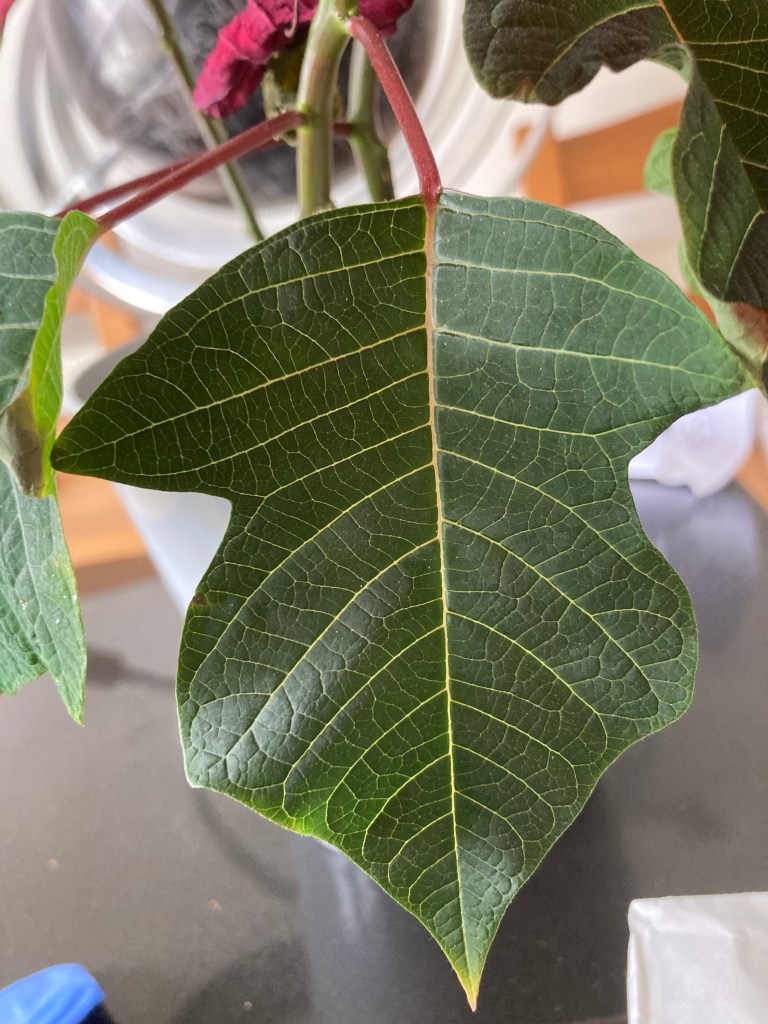
Stage 1: New Leaf 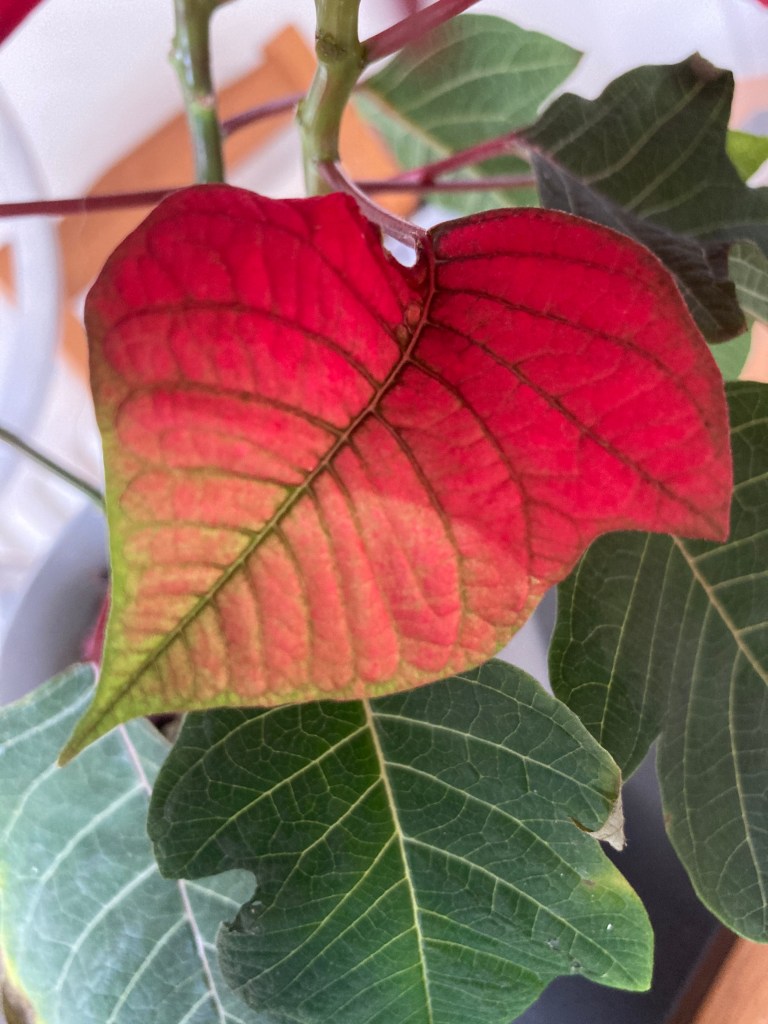
Stage 2: Changing Leaf (1) 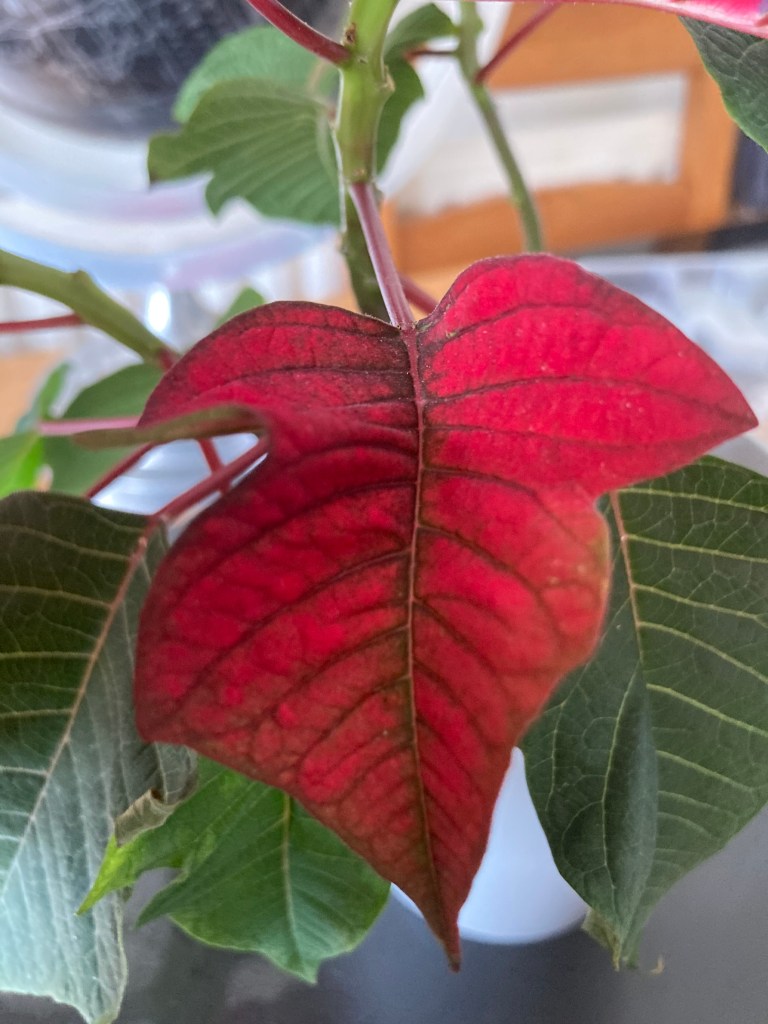
Stage 2: Changing Leaf (2) 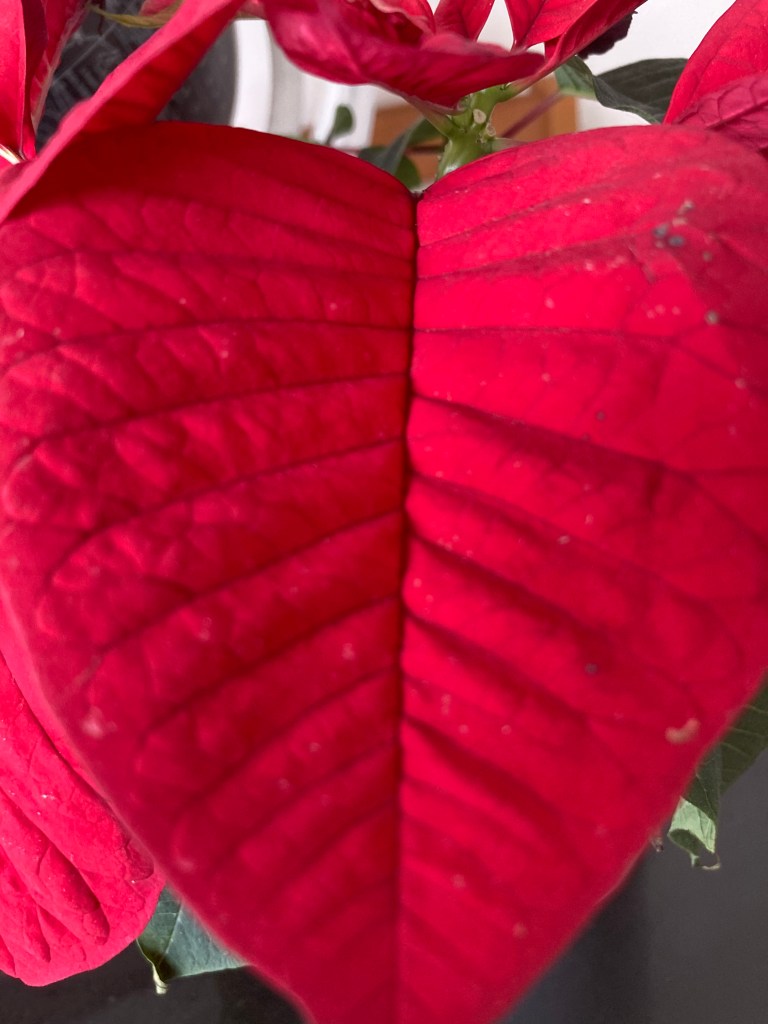
Stage 3: Developed Leaf 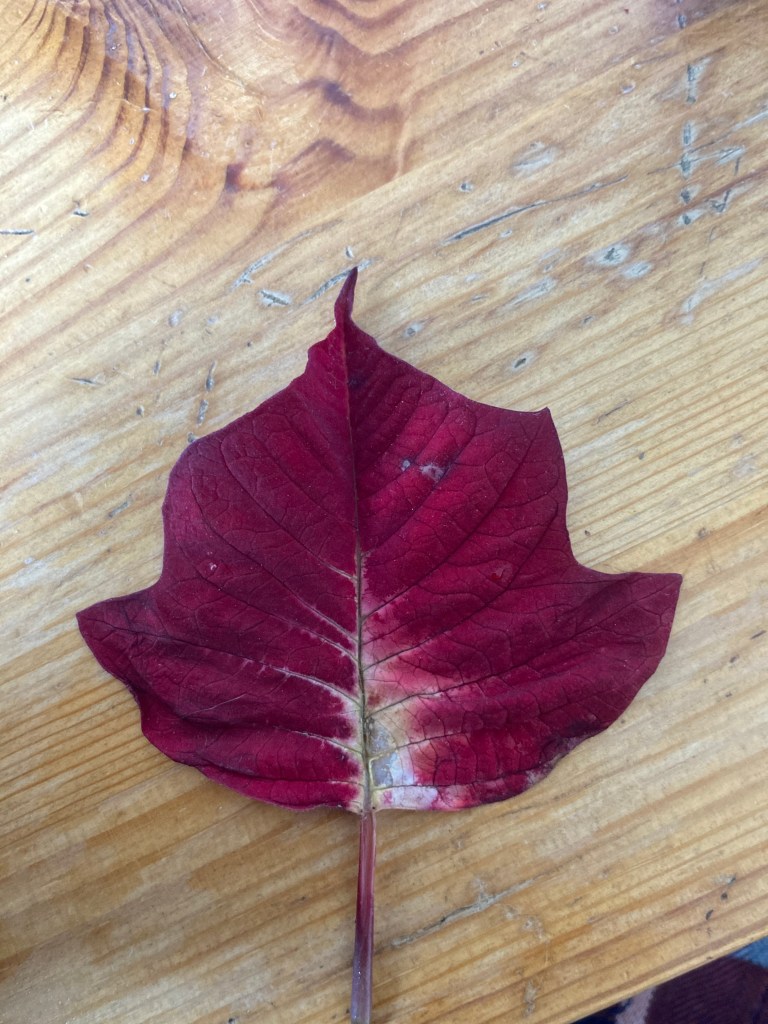
Stage 4: Mature Leaf 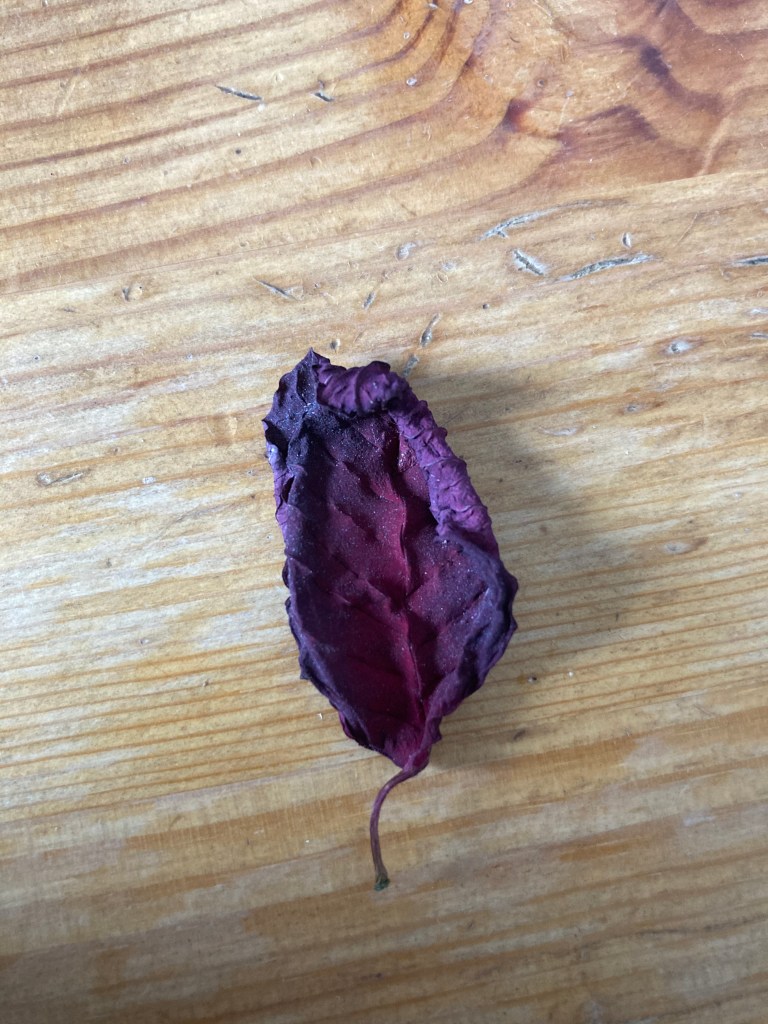
Stage 5: Dead Leaf
I also really enjoy working with the human form and the flowing lines offered within it. Having looked back on my earlier works, I decided to combine the concepts of some of my favourite techniques and most interesting pieces with the colours and textures found in the leaves at various stages somehow.

Finally, I wanted to also consider the works of several artists whose work I had researched throughout the course in order to attempt to draw on their skills and inspiration.

Fig. 1. O’keefe, G. Black Iris (1926) 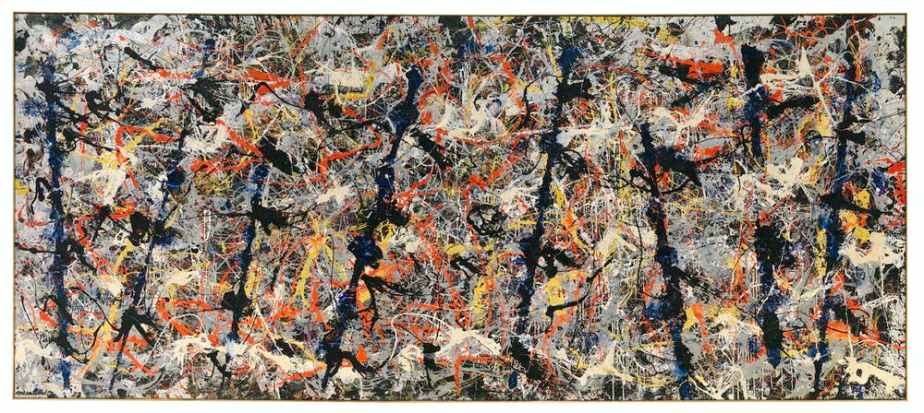
Fig. 2. Pollock, J. Autumn Rhythm (Number 30) (1950) 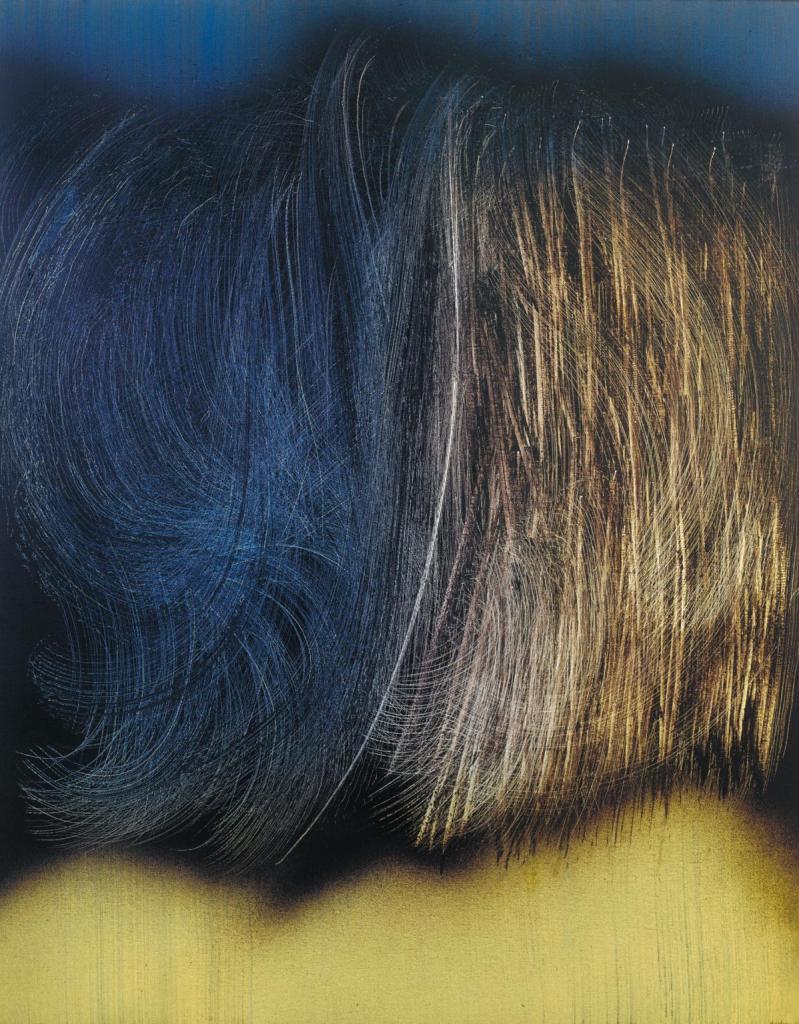
Fig. 3. Hartung, H. T1963-R6 (1963) 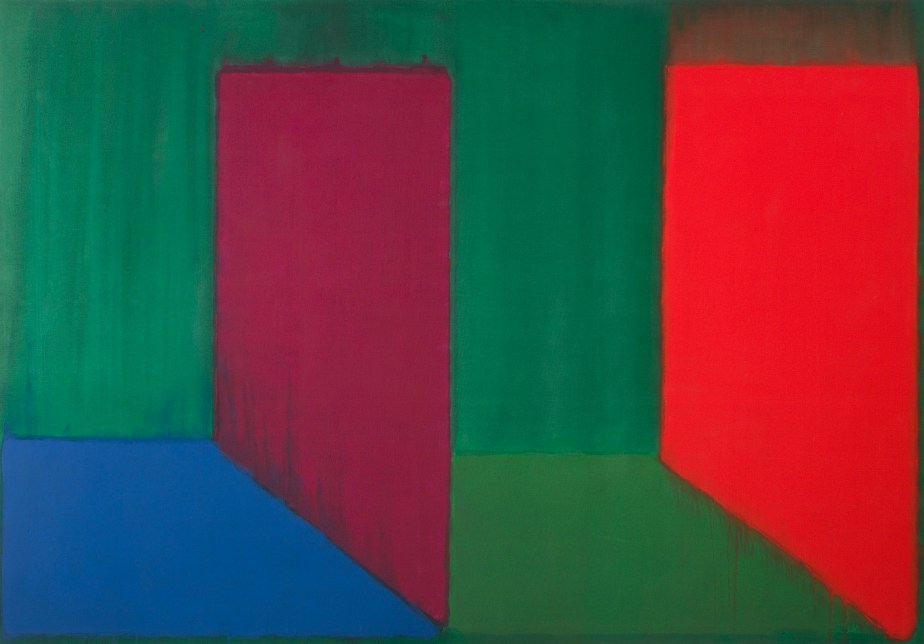
Fig. 4. Hoyland, J. 7.11.66 (1966) 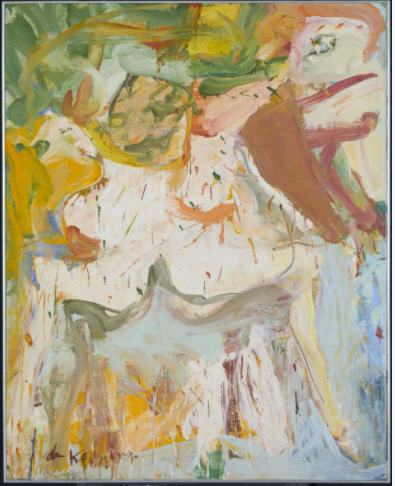
Fig. 5. de Kooning, W. The Visit (1966-7) 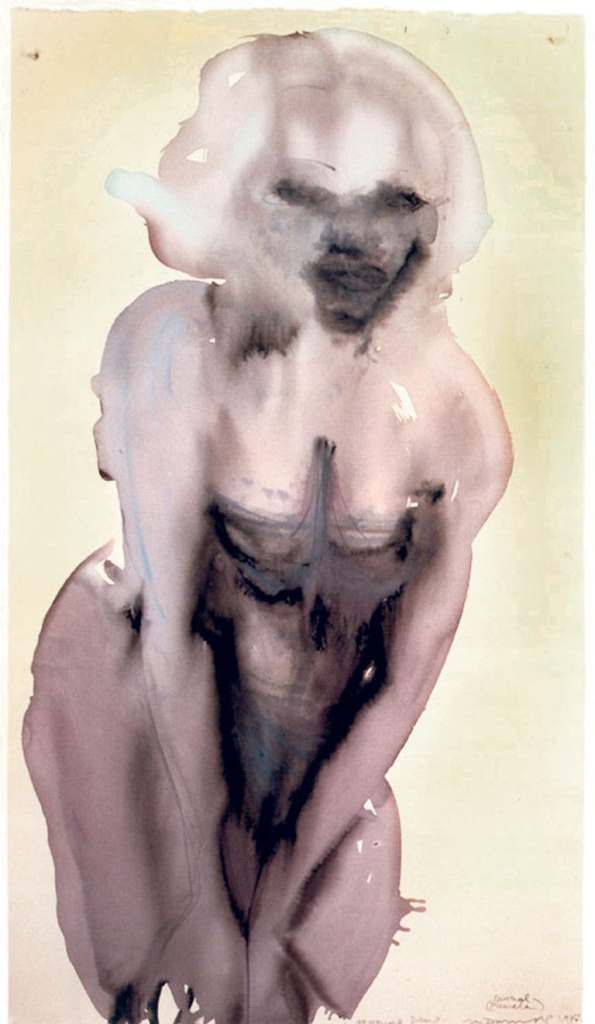
Fig.6. Dumas, M. Morning Dew (1997) 
Fig. 7. Jovanovic, B. Bird (2010) 
Fig. 8. Tinei, A My Body Rules Me (2010) 
Fig. 9. Seal, I The Beating Dodges the Question (2015) 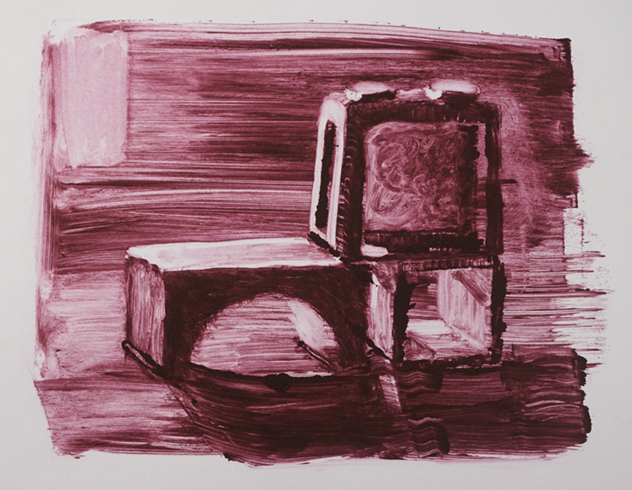
Fig. 10. Fuller, N Lion (2016) 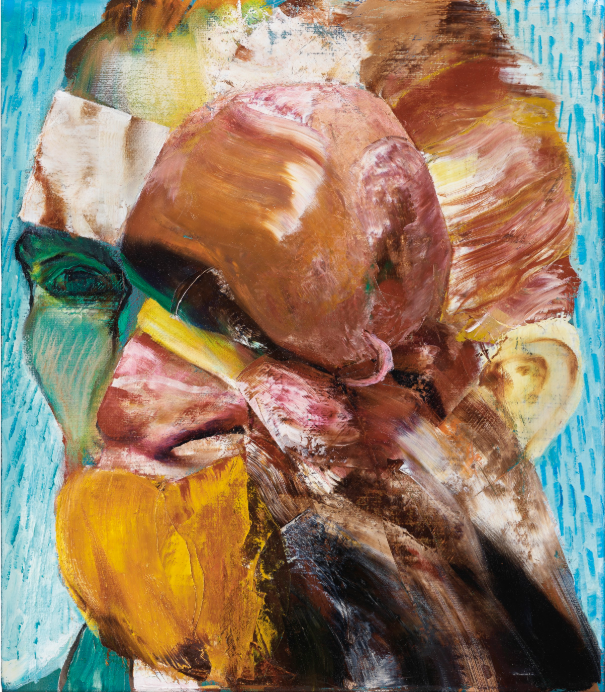
Fig. 11. Ghenie, A The Lidless Eye (2017) 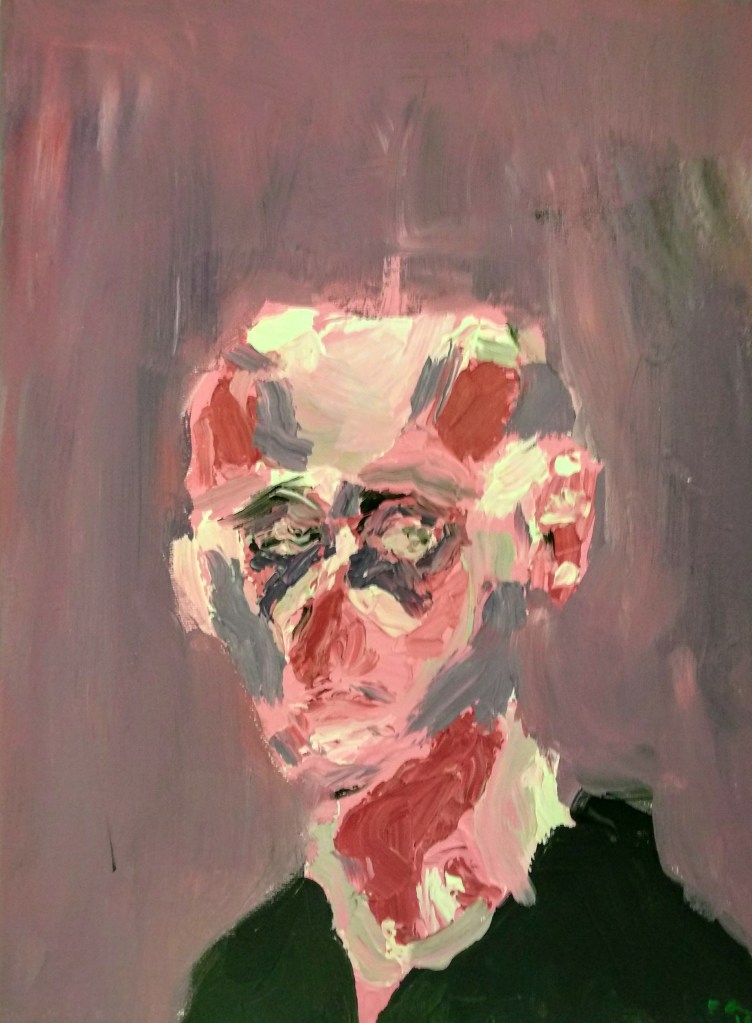
Fig. 12. Coltsmann, F. Self-Portrait 2/18 (c. 2019)
Technique
Having settled on my theme and also considering each stage closely, I feel it would be best to create my pieces simultaneously and to build them up in stages (i.e. beginning with an underpainting to layout my basic measurements and to plot tonal differences). I also think the texture of the leaves appears to change as well as the colour, and so I feel this is also something I want to consider within my pieces. For instance, the new leaf is rather smooth and quite shiny in appearance. The changed leaf is softer and does have the qualities of a petal compared to the smooth, solidness of a leaf. Finally, the dead leaf is crunchy and brittle, though the stem part still has quite a rubbery texture to it. These are all rather exciting and interesting components I wish to include within my pieces. I think these differences will bring interest to my series, as opposed to all the pieces simply being of the same thing from different angles, for example.
Painting One: New Leaf / Ballerina Pose One
For this piece, I wanted to show the fullness of a new leaf, with its healthy glow and texture. I carried this piece out in the following stages:
- Stage 1: Basic sketch on the support of my chosen ballerina pose.
- Stage 2: I then applied a layer of modelling paste, but in a smooth manner as I wanted it to create a contour beneath the layers of paint yet to be applied and layered in such a way that the flow of each area moves in the direction it appears to.
- Stage 3: I then applied a wash of the base colour to the piece ready to build upon and to serve as a background.
- Final Stage / Finished Piece: I then used the base colour as one would neutral grey and worked from both lighter and darker on the hue’s scale to show the highlights and shadows as accurately as possible.
Considered Leaf 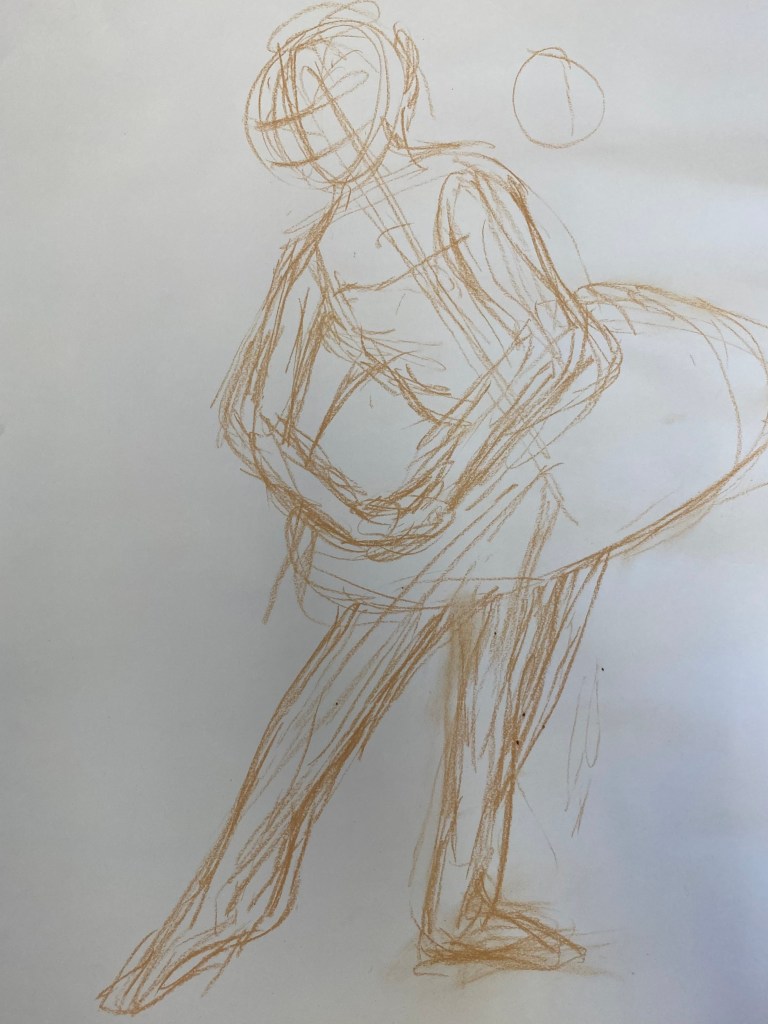
Stage 1 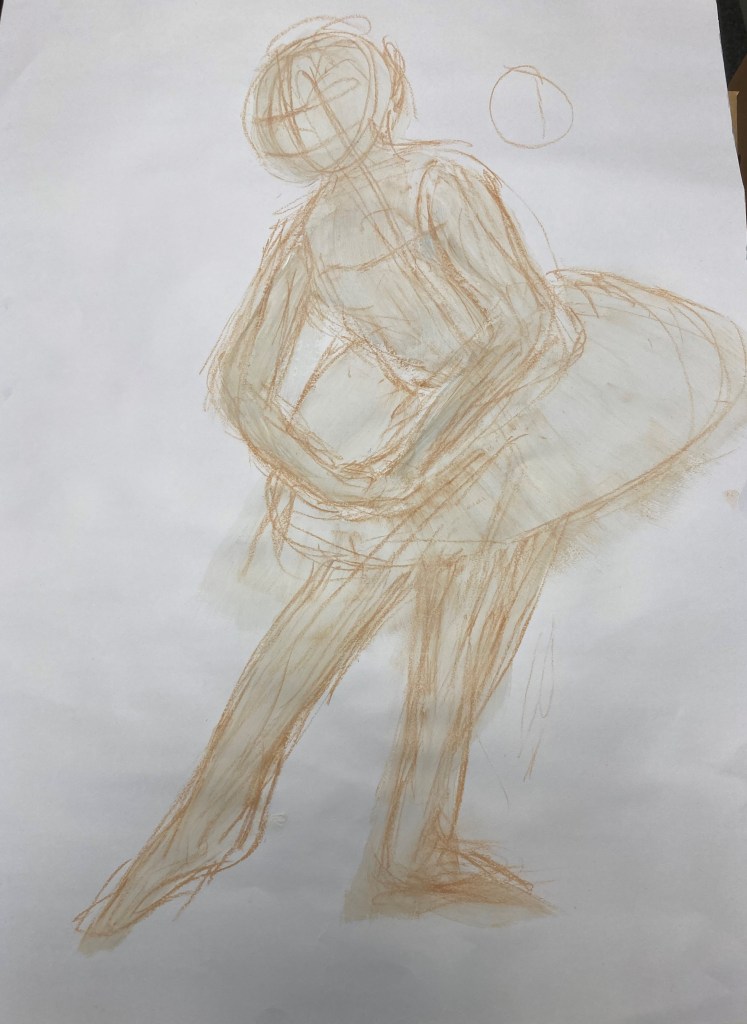
Stage 2 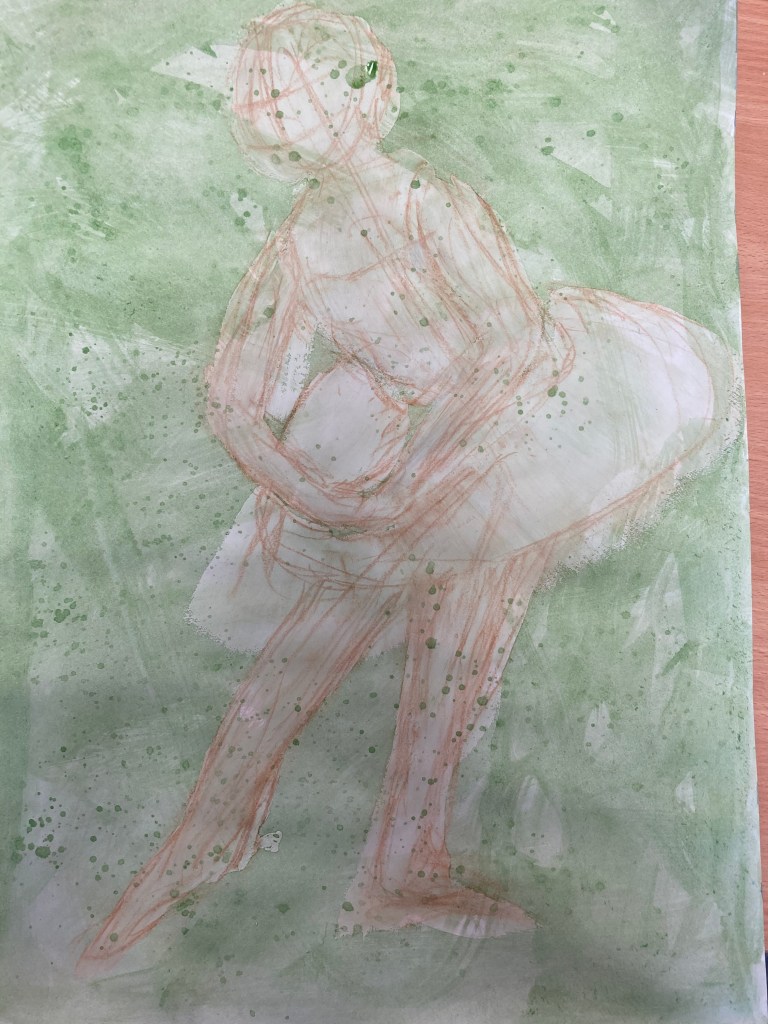
Stage 3 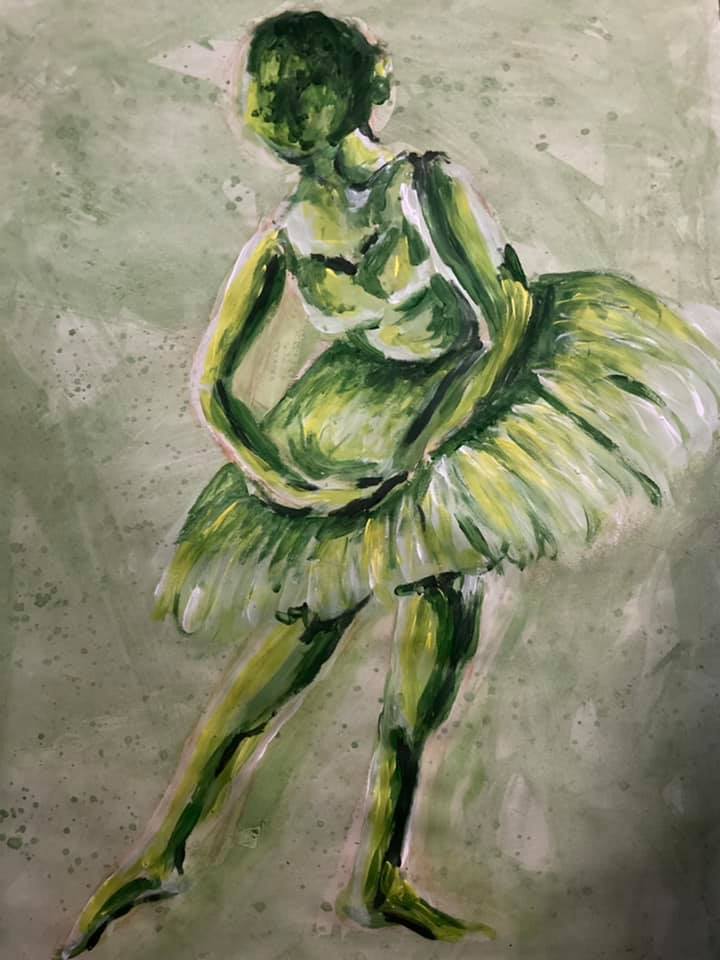
Finished Piece
I think this piece has been rather successful and is rather believable as a whole. I really enjoyed working with this pose and feel the green and touches of yellow have really worked well to show the youth and buoyancy found within the flesh of a new lef.
Painting Two: Changing Leaf / Ballerina Pose Two
For this piece, I wanted to show the fullness of the leaf, but now with slightly more defined texture and a shift in the leaf’s colouring and maturity. I carried this piece out in the following stages:
- Stage 1: Basic sketch on the support of my chosen ballerina pose.
- Stage 2: I then applied a layer of modelling paste, but this time in a slightly rougher and vivid manner as, again I wanted the contour beneath the layers of paint yet to be applied to flow in the direction it appears to, but in a much sharper way.
- Stage 3: I then applied a wash of the base colour to the piece ready to build upon and to serve as a background.
- Final Stage / Finished Piece: I then used the base colour as one would neutral grey and worked from both lighter and darker on the hue’s scale to show the highlights and shadows as accurately as possible. This time, however, the base colour was to be different to the background wash due to the changes taking place within the leaf at this stage.
Considered Leaf 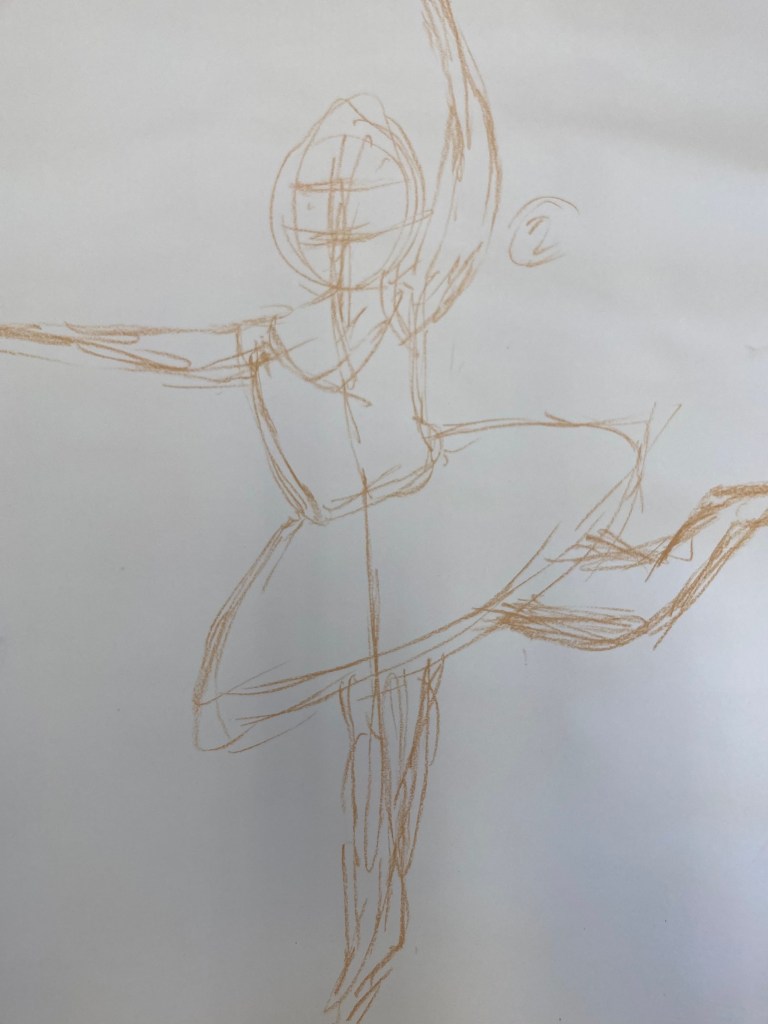
Stage 1 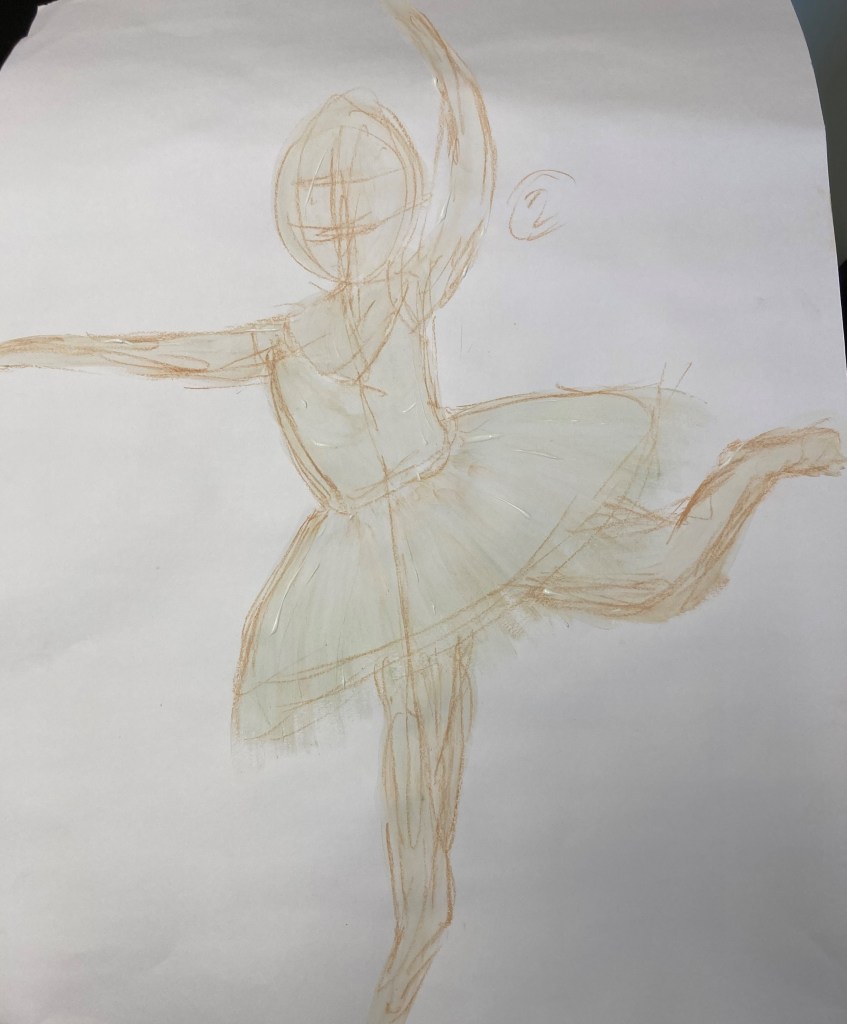
Stage 2 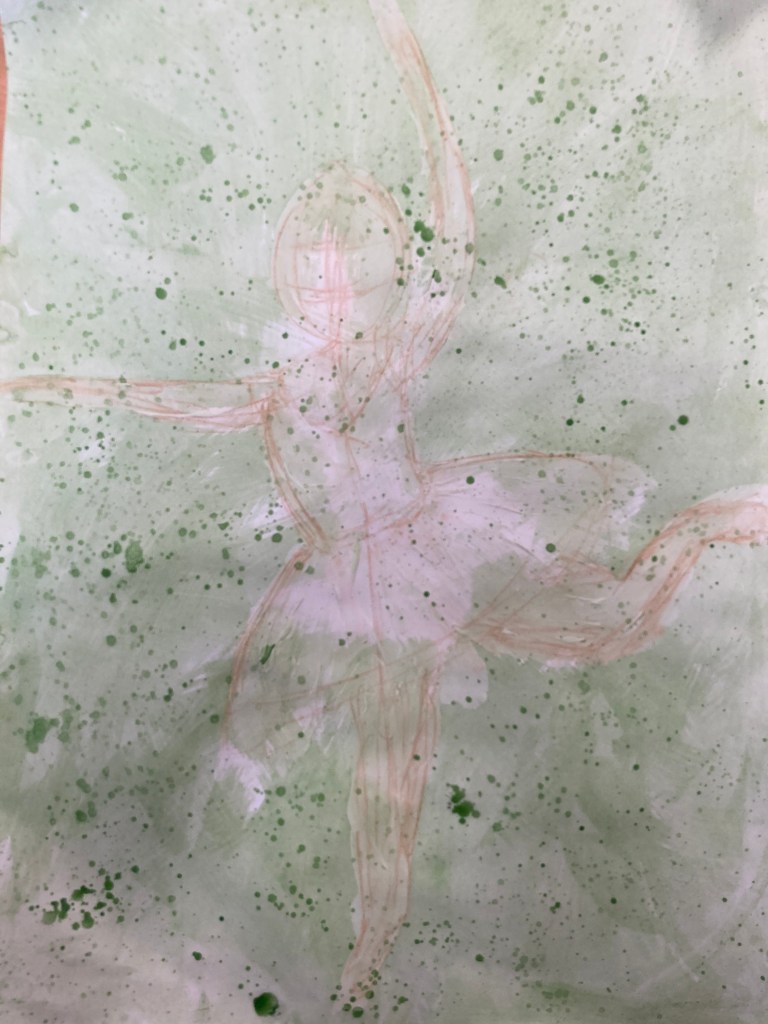
Stage 3 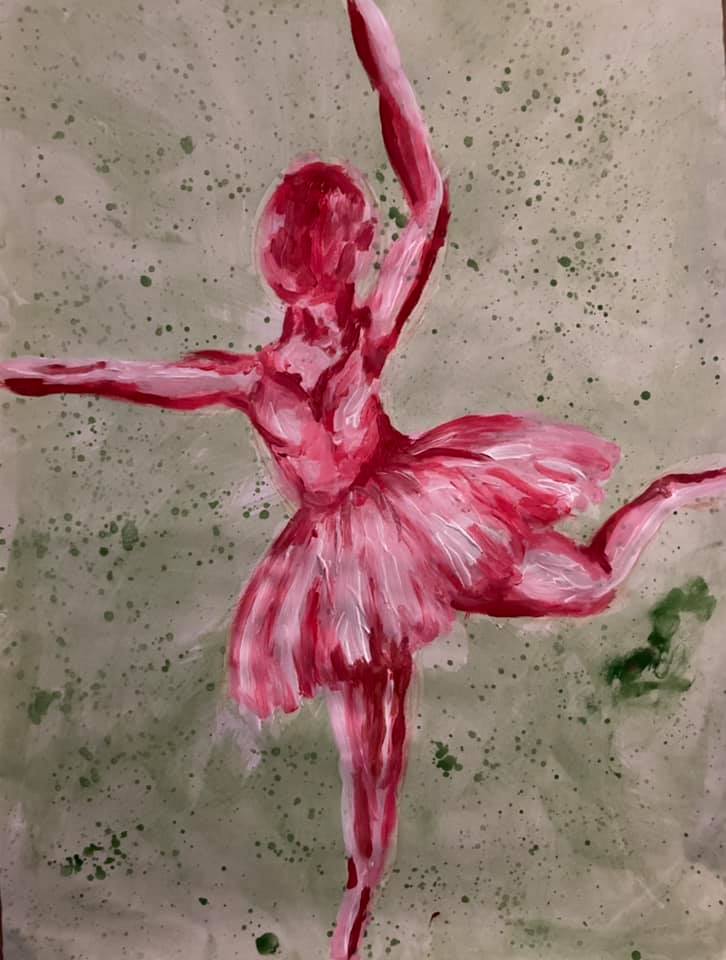
Finished Piece
I found this piece to be a little harder to complete due to the difference in the colours, yet once I began properly, I found the technique I had so become accustomed to just flowed naturally and developed an interesting result.
Painting Three: Developed Leaf / Ballerina Pose Three
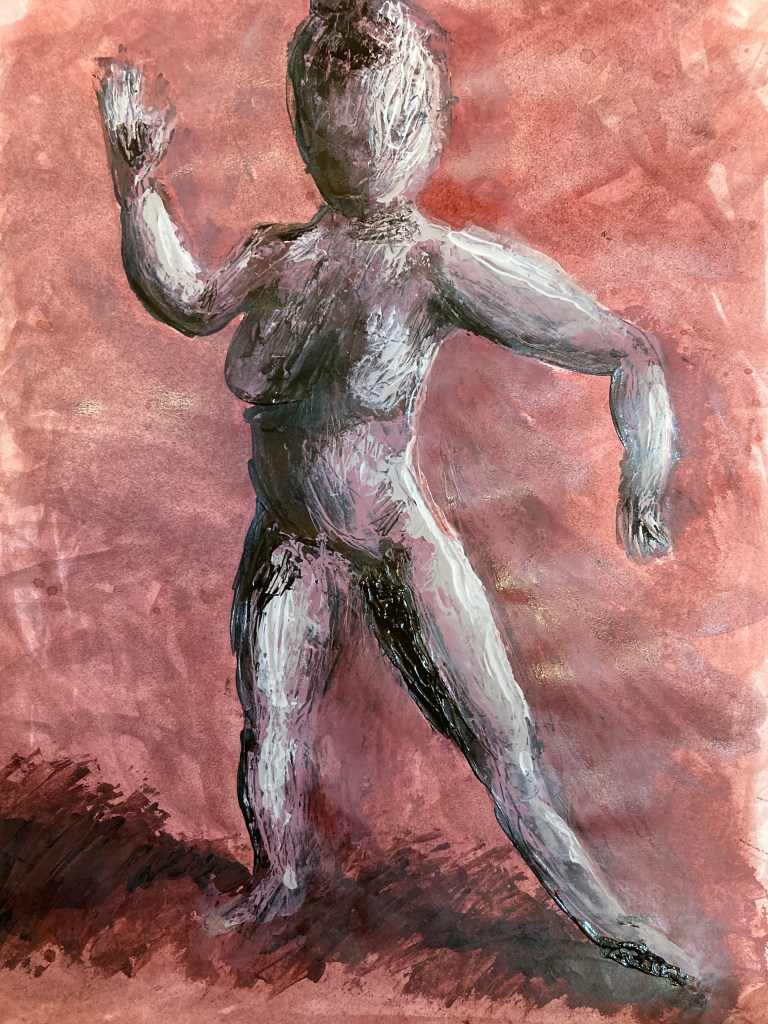
For this piece, I wanted to show the maturity and boldness of the leaf, with its its vibrant and striking colour yet also the delicate and fleeting nature of that beauty’s texture. I carried this piece out in the following stages:
- Stage 1: Basic sketch on the support of my chosen ballerina pose.
- Stage 2: I then applied a layer of crackle effect texture to show that whilst the leaf is in its adulthood and its most beautiful, the cracks of its age are now beginning to show through, just as a woman in her thirties is in their prime of beauty, but the slight appearance of lines begin to show through as a reminder of the frailty of that beauty.
- Stage 3: I then applied a thin coat of paint in the colour I had chosen to represent this stage of the process, red. I used the ‘neutral’ or ‘base’ hue of the colour to be able to move up and down the scale of colour intensity.
- Final Stage: To finish this off, I applied more and more white paint to the base colour to show the highlighted areas of the piece and then applied darker hues to show the shadows within the piece.
Considered Leaf 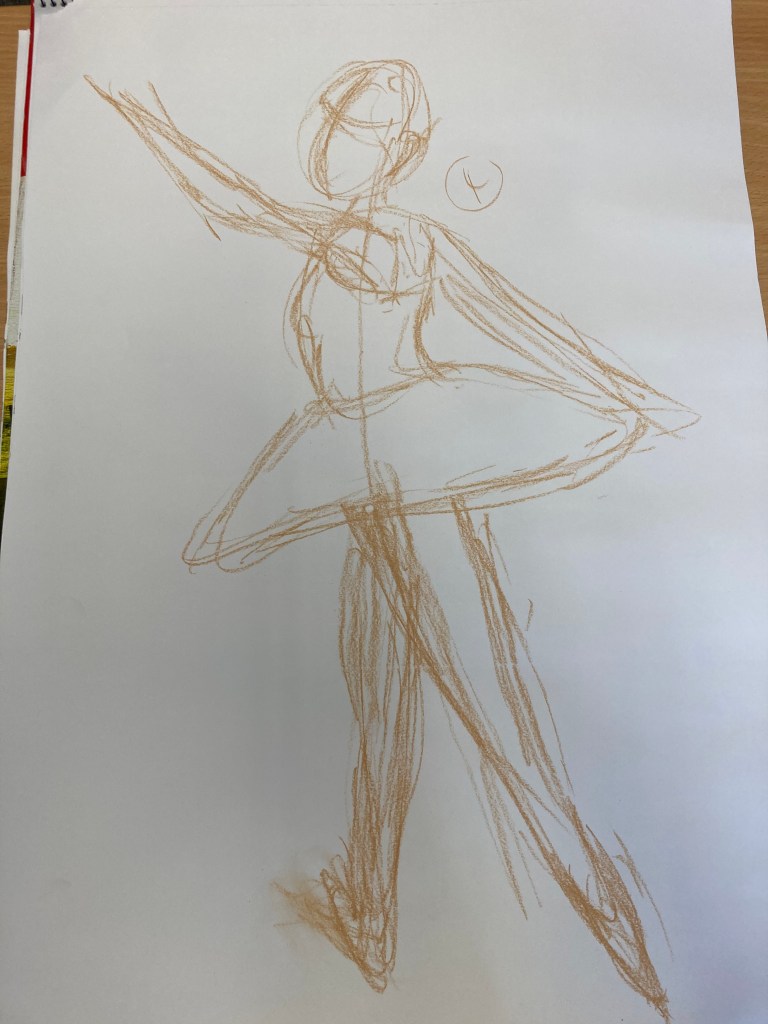
Stage 1 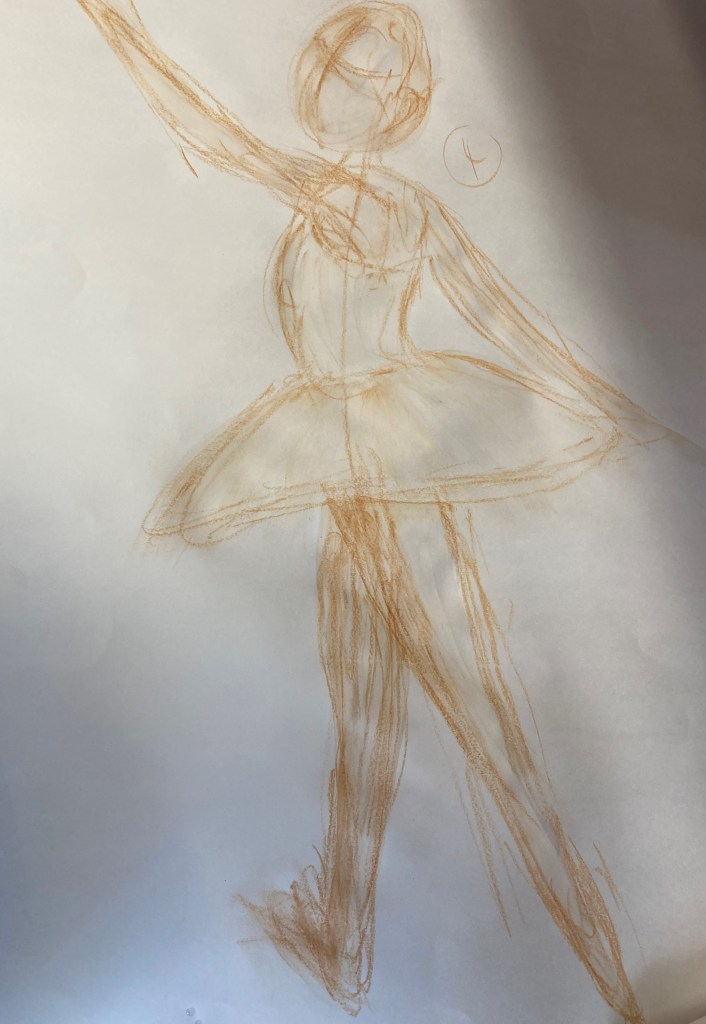
Stage 2 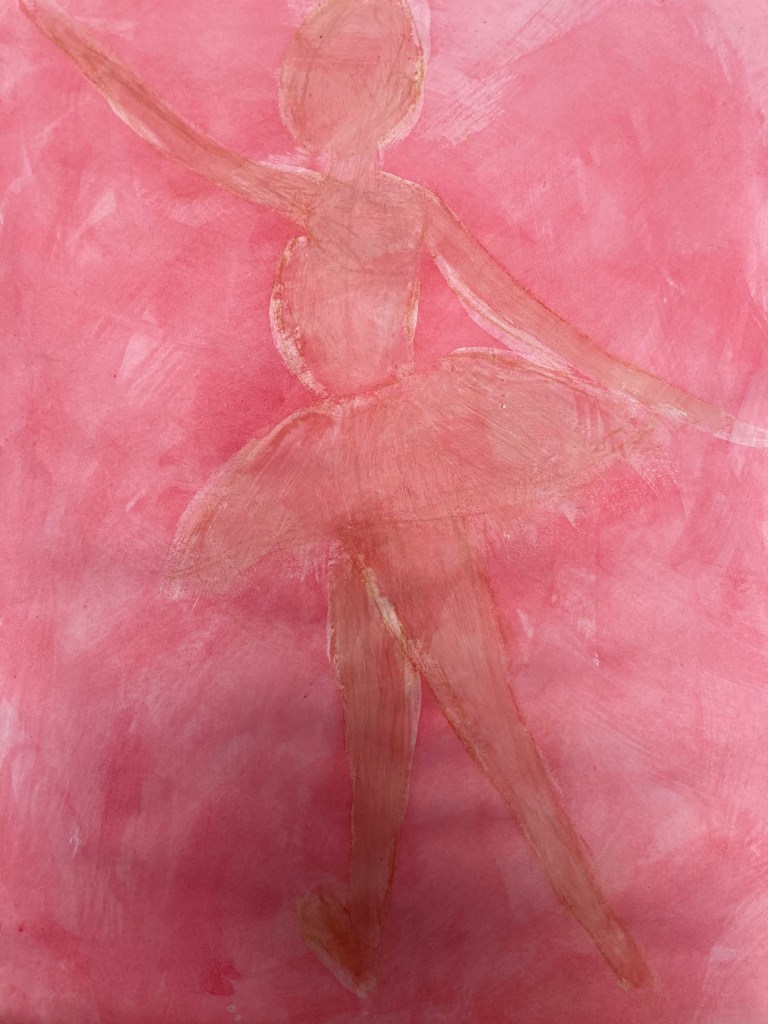
Stage 3 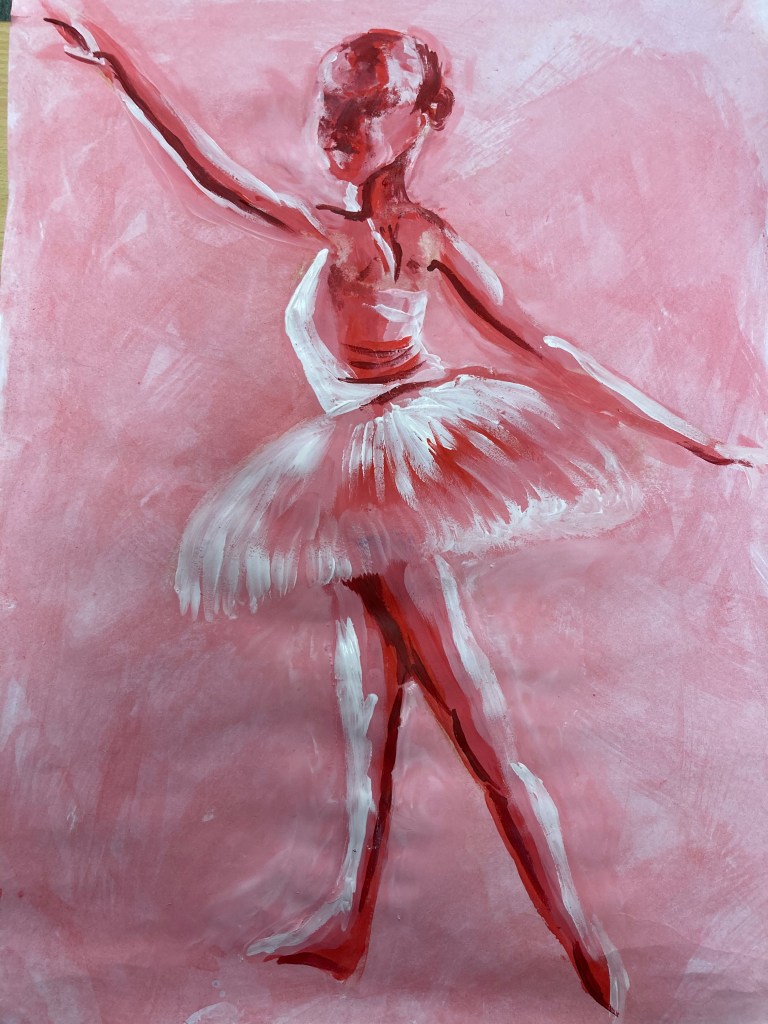
Finished Piece
This was actually the first piece in the series that I completed and, writing this before continuing the rest (having achieved the first three stages simultaneously), I was rather pleased with the outcome and thought it actually rather beautiful and striking to behold, due to holding a fluidity and ‘juicy’ substance within it. I also rather like the way the suggestion of the face has created an almost sinister and doll like, which I find rather fascinating!
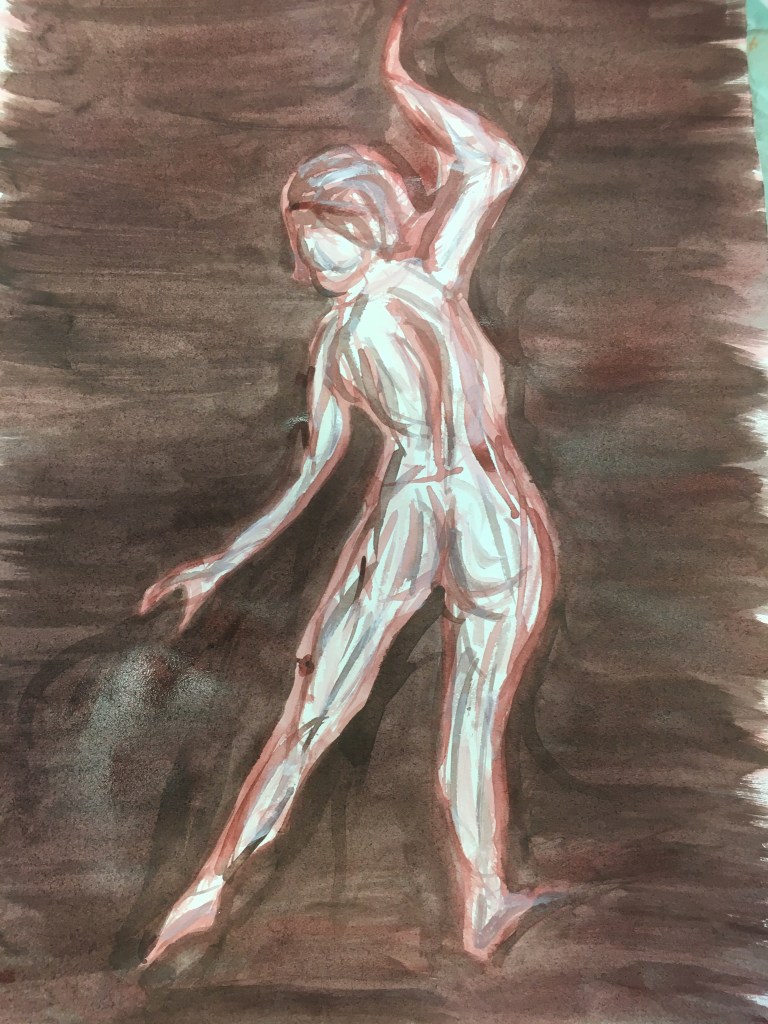
Painting Four: Mature Leaf / Ballerina Pose Four
For this piece, I wanted to show the change in the leaf’s beauty with the decay process taking hold, yet the leaf still refuses to relinquish its hold on its beauty and simply adapts to a new form of the same. I carried the piece out in the following stages:
- Stage 1: Basic sketch on the support of my chosen ballerina pose.
- Stage 2: I then applied a layer of texture paste (with the consistency of sand) to show the progression in the decay process.
- Stage 3: I then applied a wash of the base colour to the piece ready to build upon and to serve as a background.
- Final Stage / Finished Piece: I then used the base colour as one would neutral grey and worked from both lighter and darker on the hue’s scale to show the highlights and shadows as accurately as possible.
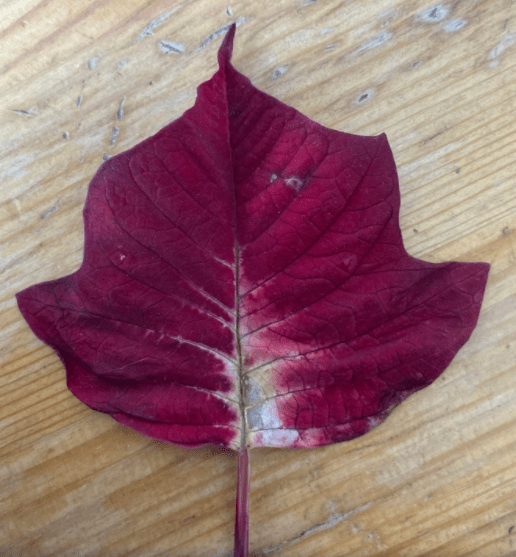
Leaf Considered 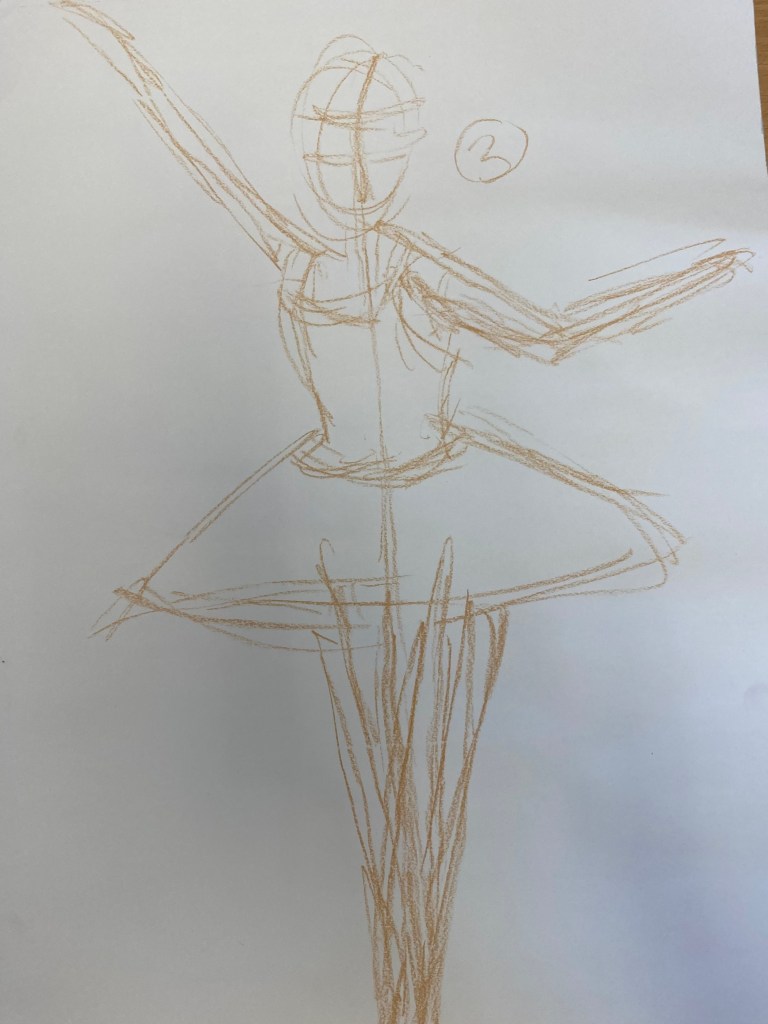
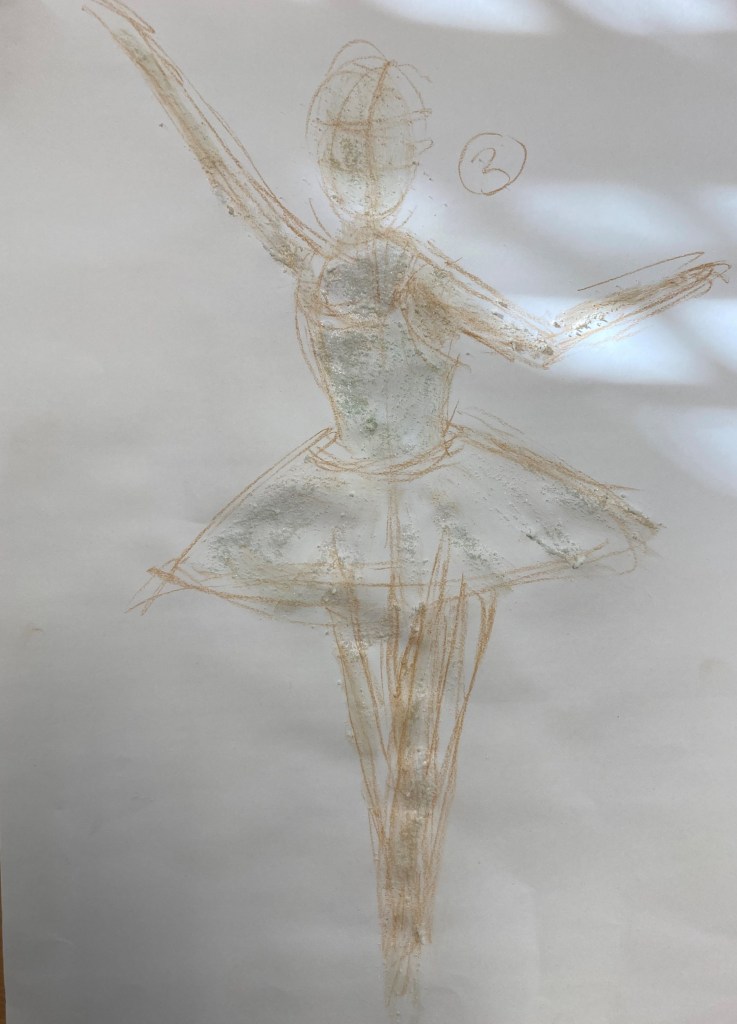
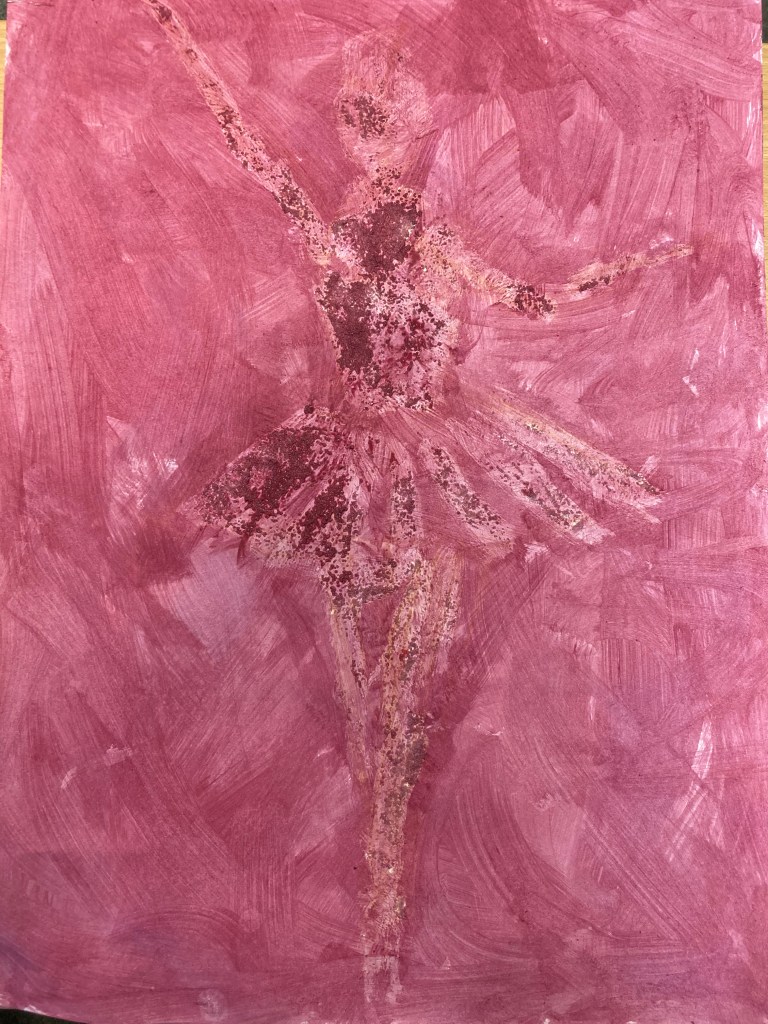
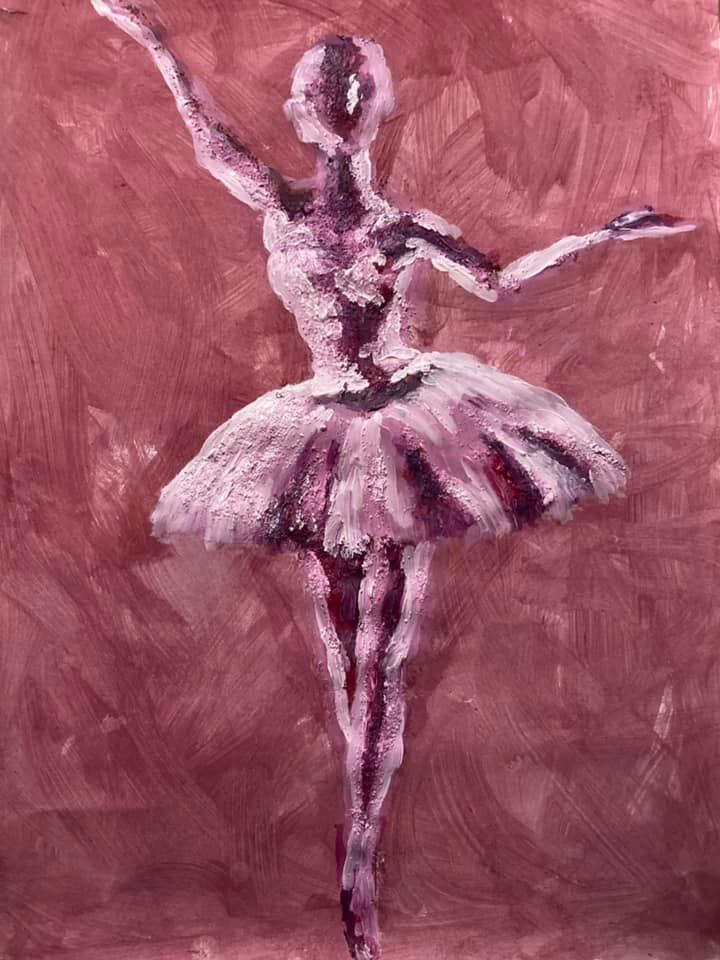
Finished Piece
I really enjoyed working on this piece and think the addition of the texture paste in certain areas really does make the piece interesting but, more so from the perspective of the artist, exciting to work with and intriguing as to what can be achieved from it.
Painting Five: Dead Leaf / Ballerina Pose Five
For this piece, I wanted to show the final stage of the leaf’s life cycle. Throughout the whole process, the leaf has retained such a level of beauty and vibrancy, with the texture becoming more prominent throughout the aging process until this final stage. I carried the piece out in the following stages:
- Stage 1: Basic sketch on the support of my chosen ballerina pose.
- Stage 2: I then applied a layer of the sand texture paste to the tutu as it appears to be jumping from the page and also modelling paste to the figure.
- Stage 3: I then applied a wash of the base colour to the piece ready to build upon and to serve as a background.
- Final Stage / Finished Piece: I then used the base colour as one would neutral grey and worked from both lighter and darker on the hue’s scale to show the highlights and shadows as accurately as possible.

Leaf Considered 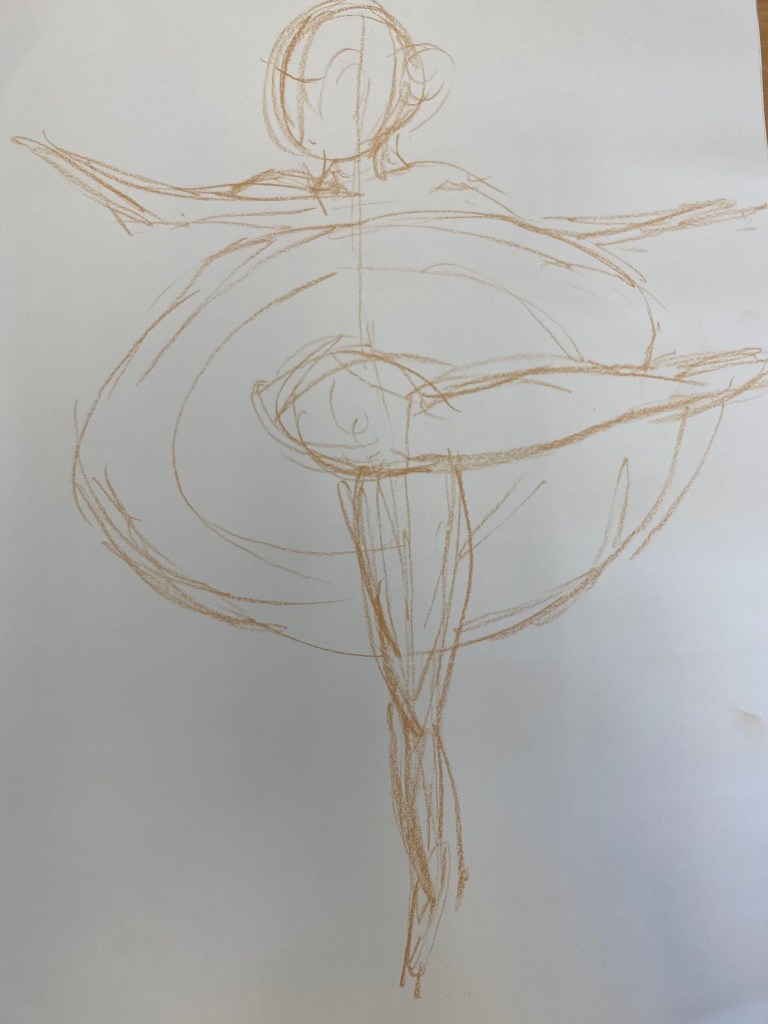
Stage 1 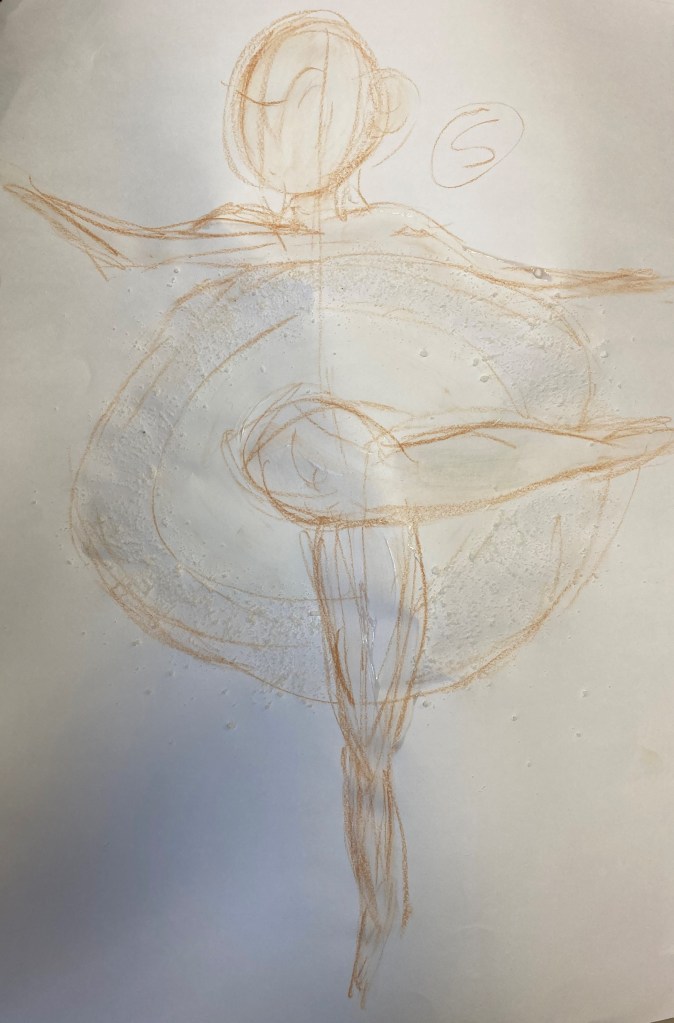
Stage 2 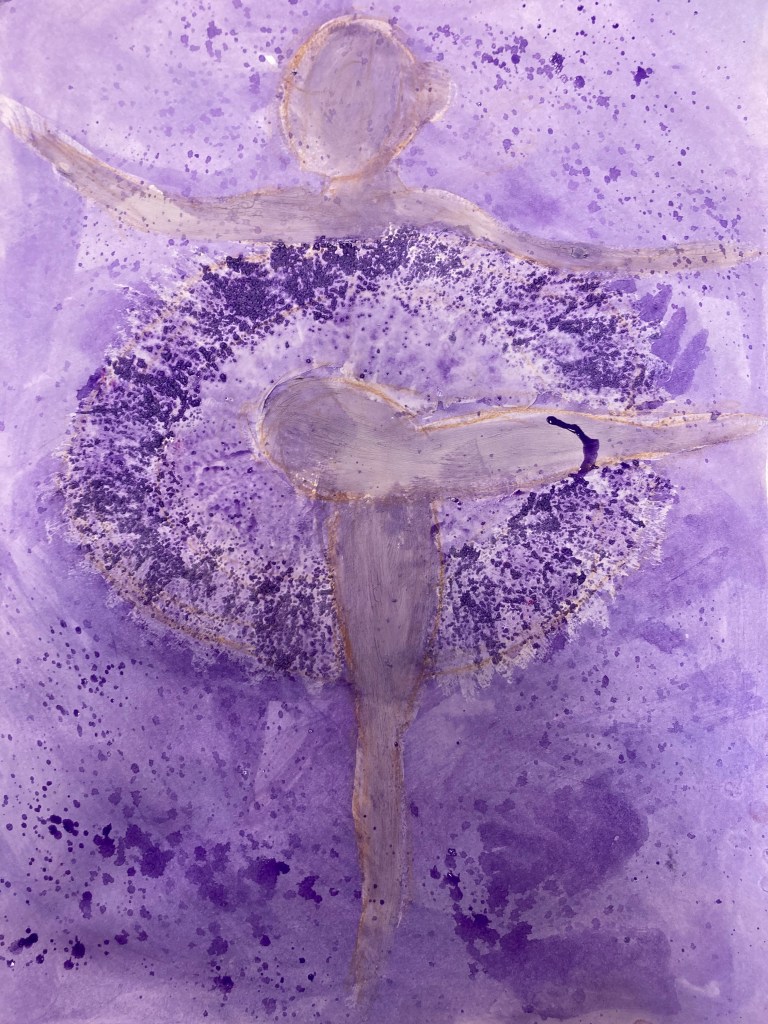
Stage 3 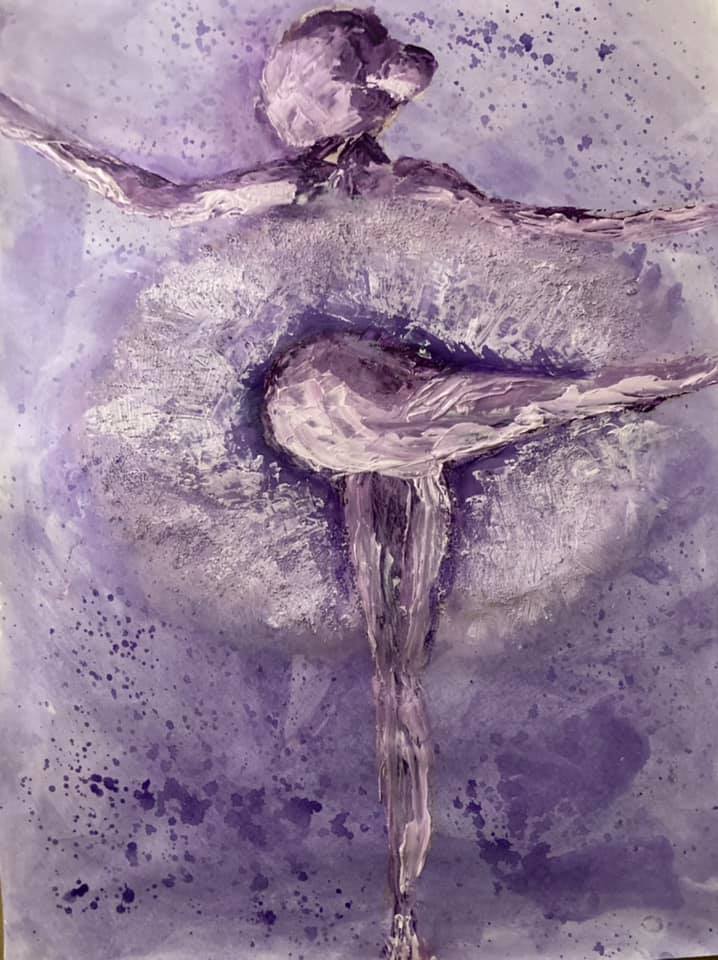
I think this is by far my favourite piece and, whilst originally chosen to be the fourth piece in the series, I feel it just has that extra ‘wow’ factor and a burst of movement and power to see the series out with a bang! I think this piece has come together the best and just calls to me. I feel I could look at it for hours on end, which leads me to feel it truly has been a success.
Evaluation of Series
I feel this series really shows just how far I have come as a painter within all areas and aspects of my practice. I believe I have listened to my tutor well and created my own technique from bearing in mind that of the Old Masters of working from dark to light, watery to thick, and have found a way of making this work for me personally, which I now feel is helping me to build and refine my identity as an artist. I also think I have come far in respect of my technical skills, having drawn the ballerinas quickly and freehand.
I decided to adapt the method in which I applied the paint to the support for each piece, beginning as bold and vibrant, moving to smooth and demure, and then looser and more aggressive as the decay takes hold. The most delicate painting is that of the developed leaf, due to it having reached a calm and settled time within its lifecycle. I quite like this central calm within the series, such as the eye of a storm and the central focus surrounding the chaos of new and decaying life.
Overall, I feel this series to be by far my most powerful and exciting work.
List of Illustrations
Fig. 1. O’keefe, G. (1926) Black Iris [Oil on canvas] At: https://www.metmuseum.org/art/collection/search/489813 (Accessed on 25 June 2020)
Fig. 2. Pollock, J. (1952) Blue Poles [Oil, enamel, aluminium paint, glass on canvas] At: https://theconversation.com/heres-looking-at-blue-poles-by-jackson-pollock-51655 (Accessed on 4 January 2021)
Fig. 3. Hartung, H. (1963) T1963-R6 [Acrylic paint on canvas] At: https://www.tate.org.uk/art/artworks/hartung-t1963-r6-t00816 (Accessed on 4 January 2021)#
Fig. 4. Hoyland, J. (1966) ‘7.11.66’ [Acrylic on canvas] At: https://abcrit.org/2017/10/09/80-paul-behnke-writes-on-john-hoyland-at-pace-n-y/ (Accessed on October 2020)
Fig. 5. de Kooning, W. (1966-7) The Visit [Unknown] At: https://www.tate.org.uk/art/artists/willem-de-kooning-1433 (Accessed on 4 January 2021)
Fig. 6. Dumas, M. (1997) ‘Morning Dew’ [Ink wash, watercolor and metallic acrylic on paper] At: (Accessed on 6 October 2020)
Fig. 7. Jovanovic, B. (2010) Bird [Painting] At: https://fineartamerica.com/featured/bird-branka-jovanovic.html (Accessed on 29 December 2020)
Fig.8. Tinei, A (2010) ‘My Body Rules Me’ [Oil on Canvas] At: http://ilikepaints.blogspot.com/2012/04/alexander-tinei.html (Accessed on 27 March 2020)
Fig. 9. Seal, I (2015) ‘The Beating Dodges the Question,’ [Oil on canvas] At: https://carlfreedman.com/artists/ivan-seal/ (Accessed on 18 March 2020)
Fig. 10. Fuller, N (2016) ‘Lion’ [Monoprint] At: https://neillfullerpaintings.com/prints (Accessed on 18 March 2020)
Fig. 11. Ghenie, A (2017) ‘The Lidless Eye’ [Oil on canvas] At: https://www.christies.com/lotfinder/Lot/adrian-ghenie-b-1977-the-lidless-eye-6236031-details.aspx (Accessed on 27 March 2020)
Fig. 12. Coltsmann, F. (c. 2019) Self-Portrait 2/18 [Acrylic on canvas] At: https://www.studioupstairs.org.uk/product/self-portrait-218/ (Accessed on 30 May 2020)
 Rachael's OCA Blog: Painting One: The Practice of Painting