

Exercise One: View from a Window or Doorway
Artist Research
Before I began this exercise, I carried out some research into what other artists had created and the methods they had used to show the world through an open window.
Raoul Dufy
Fig. 1. Dufy, R. View Through a Window, Nice (1925) Fig. 2. Dufy, R. Console with Two Windows (1948) Fig. 3. Dufy, R. Window at Nice (1953)
Firstly, I began by looking at the recommended artist, Raoul Dufy. I was immediately drawn to the boldness of the colours used in the pieces overall. It is also easily noted that these pieces are rather cartoon-like in nature and rather loosely applied, yet still hold a fair amount of depth and realism. It is clear that the artist is rather comfortable painting in this way and enjoys using the window as the frame to the world beyond. There is a sense of heat and ‘holiday’ to the exteriors with the interior being a safe retreat.
Gwen John
Fig. 4. John, G. A Corner of the Artist’s Room in Paris (1907-09) Fig. 5. John, G. Interior (1924) Fig. 6. John, G. Interior (1924)
The next artist I considered was Gwen John and it was immediately apparent from these pieces that the work is completely different to that of Dufy’s. There is a sense of warmth and cosy glowing emanating inside the room and a sense of warmth shining through from the outside. I really like how the artist has chosen views with a sharp curve in the movement of the walls as they really create depth and contrast within the piece. There is a limited palette used in these pieces and only a small amount of the strongest tonal contrasts, giving the eye a good place to focus on in a piece which is rather similar tonally in the remaining areas.
Edward Hopper
Fig. 7. Holland, J. Nighthawks (1942) Fig. 8. Holland, J. Cape Cod Morning (1950) Fig. 9. Holland, J. Office in a Small City (1953)
Finally, I considered some of the pieces created by Edward Hopper and, again, it was instantly clear that this artist had a completely different view of the world and the concept of the window. I am instantly drawn to Fig. 8. because of the strong connection it brings with regard to the way the world is at the moment due to the pandemic and having to view the world mostly through our windows. Whilst these pieces have figures included in them, it is clear they are not the immediate overall priority of the viewer, even if they are the initial object to catch the eye. We are also instantly forced to ask ourselves what the figure sees and what they are contemplating or projecting onto the landscape beyond their windows.
Reflection
The three different artists considered really are completely different in their approach. Whilst Hopper’s pieces are the boldest of the three, the fact the viewer is asked to question the thoughts of the figures within them really makes you realise that, actually, you are that figure within the works of Dufy and John. In Hopper’s, it is almost as though we are a god, viewing the world from a hidden viewpoint and unbeknownst to the figure. This is really interesting and something to bear in mind in my own pieces.
Final Piece
I decided to carry out this exercise using my office window as my muse due the sinister nature it could hold if perceived in a certain way. The window is barred to ensure extra security for its inhabitants, yet one could also see it as an attempt to keep its inhabitants inside, such as the windows of a prison. Working nine to five, Monday to Friday, one could easily find themselves looking through this window at the beauty of the world and feel trapped; a prisoner of the conventional world. A prison of a different kind. That is what I wanted to portray within my piece; the more sinister appearance of a relatively normal and ‘invisible’ object.
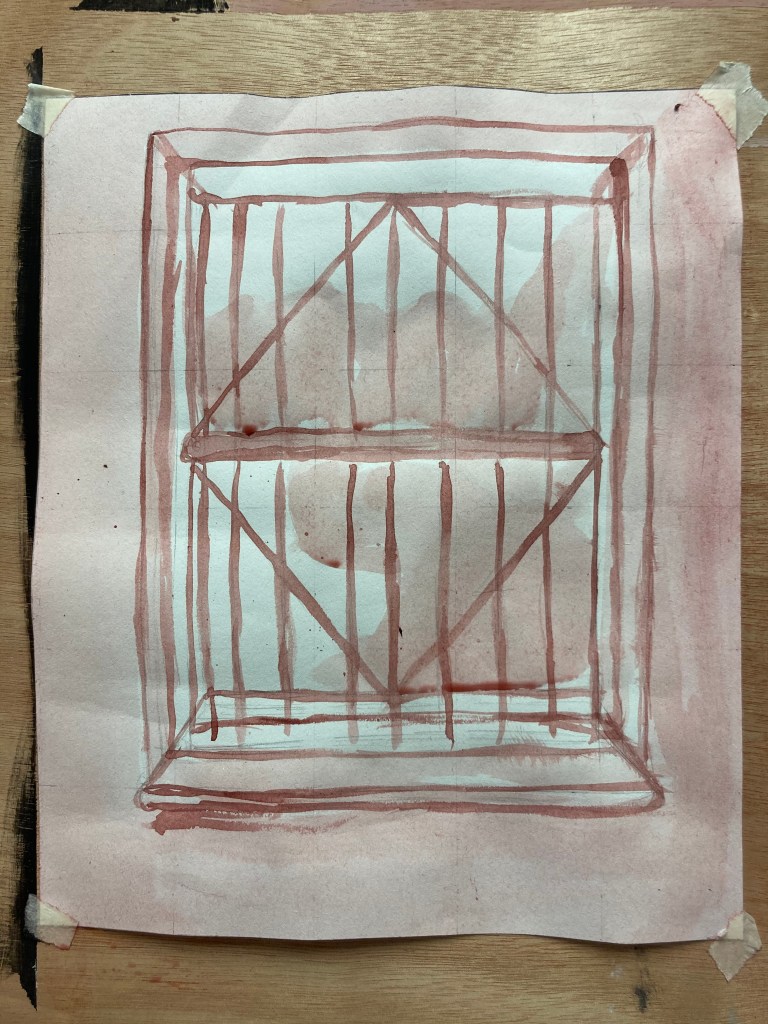
Stage 1 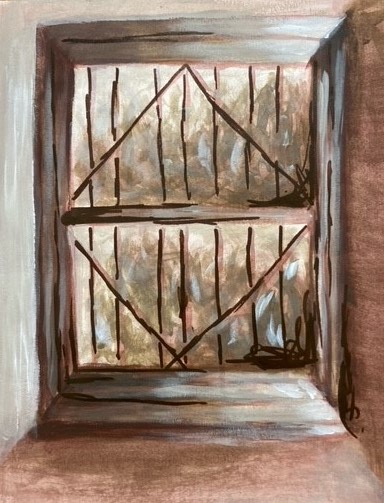
Stage 2 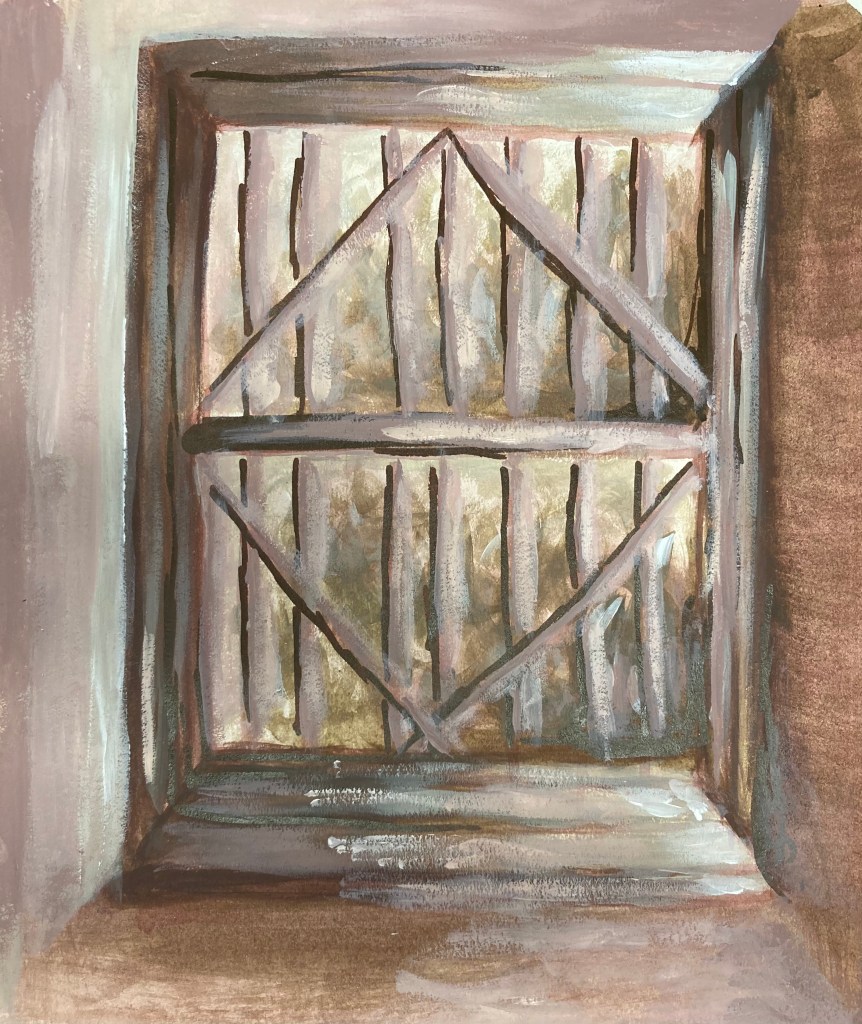
Finished Piece
Overall, I think my final piece is rather dark and moody and does seem to draw the viewer in. There are some flaws with the accuracy of the window’s frame and angling, however, I feel this adds to the overall effect of almost being pulled into a surreal vortex of unsteadiness.
Exercise Two: Hard or Soft Landscape
For this exercise, I was tasked with creating a piece from a hard or soft landscape and, having briefly looked ahead in the remaining exercises for this part, noted there was an exercise further on which is specifically relating to hard landscapes, thus I settled on the concept of a soft landscape. Also, I am rather drawn to trees and they feel rather similar to the human figure to me in their structure and fluidity.
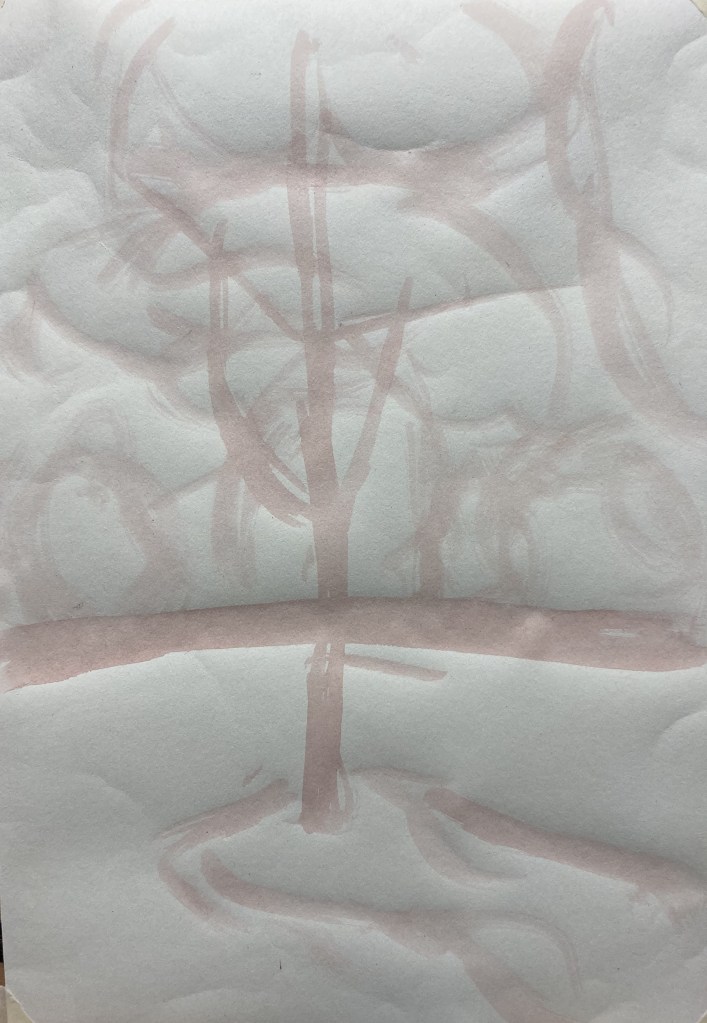
Stage 1 
Stage 2 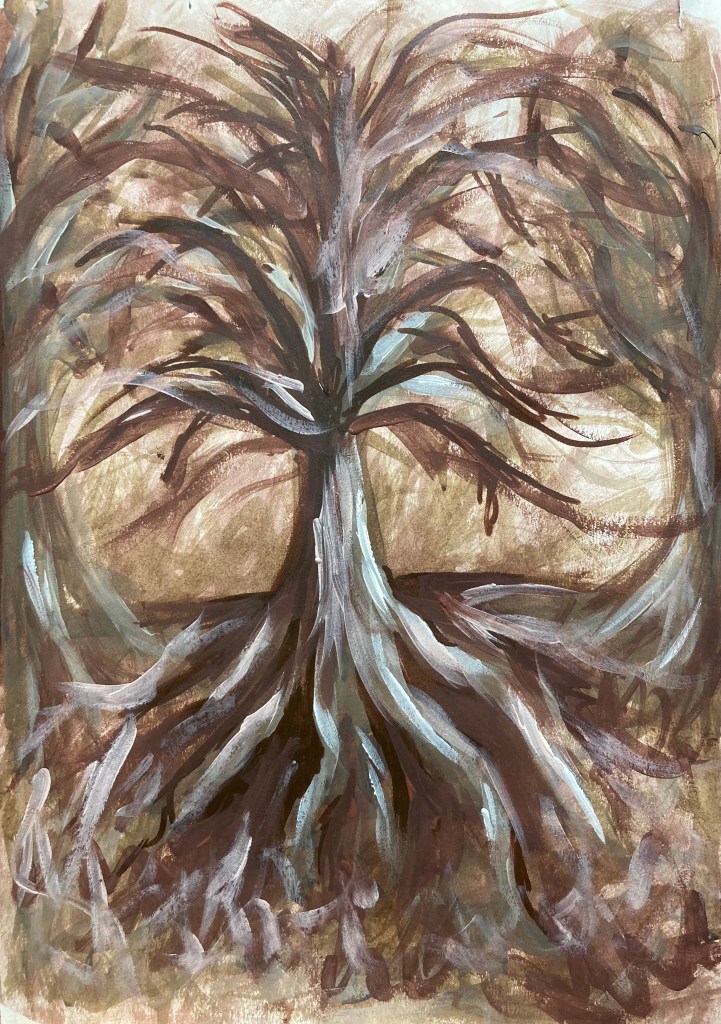
Final Piece
I settled on a group of trees quite close to my home and decided to create a focal tree in the centre with two trees in the middle ground to assist in the creation of depth within the piece.
Overall, I am rather pleased with this piece. The trunk and roots of the tree in particular are rather stunning in my opinion and really create a good sense of depth, form and movement of the light hitting the tree. I think I have been rather successful in creating the illusion of depth with the trees in the middle ground and am actually rather pleased with this result, same with the background which is simply a mere suggestion of visual information. Whilst I think the branches are a little too cluttered and almost ‘feather’ like, I do feel this has been a rather successful exercise and I have really found a colour scheme and technique which suits my style.
List of Illustrations
Fig. 1. Dufy, R. (1925) ‘View Through a Window, Nice’ [Oil painting] At: https://artsandculture.google.com/asset/view-through-a-window-nice/XQGOQQKoDB3ZTA (Accessed on 22 September 2020)
Fig. 2. Dufy, R. (1948) ‘Console with Two Windows’ [Oil painting] At: https://www.wikiart.org/en/raoul-dufy/console-with-two-windows-1948 (Accessed on 22 September 2020)
Fig. 3. Dufy, R. (1953) ‘Window at Nice’ [Oil on canvas] At: https://www.reproduction-gallery.com/oil-painting/1504070389/window-at-nice-1953-by-raoul-dufy/ (Accessed on 22 September 2020)
Fig. 4. John, G. (1907-09) ‘A Corner of the Artist’s Room in Paris’ [Oil on canvas] At: https://artuk.org/discover/artworks/a-corner-of-the-artists-room-in-paris-116863 (Accessed on 22 September 2020)
Fig. 5. John, G. (1907-09) ‘A Corner Of The Artist’s Room In Paris’ [Oil on canvas] At: https://artuk.org/discover/artworks/a-corner-of-the-artists-room-in-paris-72089/view_as/grid/search/keyword:gwen-john/page/1 (Accessed on 22 September 2020)
Fig. 6. John, G. (1924) ‘Interior’ [Oil on canvas] At: https://artuk.org/discover/artworks/interior-205297 (Accessed on 22 September 2020)
Fig. 7. Holland, J. (1942) ‘Nighthawks’ [Oil on canvas] At: https://commons.wikimedia.org/wiki/File:Nighthawks_by_Edward_Hopper_1942.jpg (Accessed on 22 September 2020)
Fig. 8. Holland, J. (1950) ‘Cape Cod Morning’ [Oil on canvas] At: https://americanart.si.edu/artwork/cape-cod-morning-10760 (Accessed on 22 September 2020)
Fig. 9. Holland, J. (1953) ‘Office in a Small City’ [Oil on canvas] At: https://en.wikipedia.org/wiki/Office_in_a_Small_City (Accessed on 22 September 2020)
 Rachael's OCA Blog: Painting One: The Practice of Painting

One thought on “Part 4: Project 1: From Inside, Looking Out”