

Preparatory Work
To prepare for my final piece for this part of the course, I decided to begin by making a list of the things required from me within the instructions and then broke these down into more manageable sections.
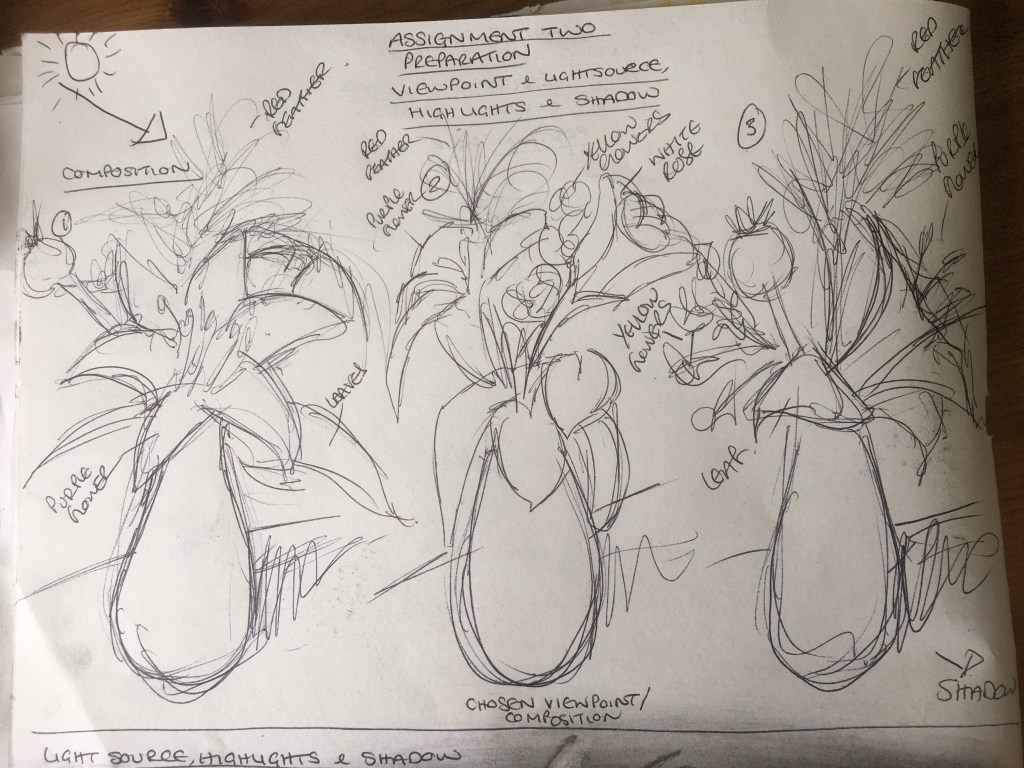
Firstly, I decided on my composition which I knew would be a bunch of artificial flowers I had due to their suitability to this assignment and variety of textures, colours and possibilities. I then placed them in several positions to try to find the most interesting viewpoint. I decided that the second was the most appealing due to its widest range of visibility of the different flowers. I was really drawn to the first one as the purple flower really did take centre stage, however, I decided to choose the second due to the triangle shape created by the flowers which reminded me of the compositional rule regarding odd numbers and triangles being more naturally appealing to the eye.
After settling on this composition and viewpoint, I then moved to considering the light source and the highlights and shadows created as a result. I decided to carry out a charcoal reductive study to note those areas with the most prominence. At this point, I had no idea which type of colour palette I would use, however, I knew the highlights and shadows would be important regardless.
I then moved on to considering how the object sat in space and carried out two more reductive drawings, the first leaving the positive space in the charcoal and the second leaving the negative space in the charcoal. I found this really quite interesting as, whilst I did not know what my colour scheme would be, it was helpful in working out whether I wanted the flowers to stand out from the background or to allow the background to overpower them, almost creating an optical illusion in itself by encouraging the grounds to battle it out for pride of place.
Next, I decided how I would treat each of the objects in the piece as they all required different methods to reflect them in an accurate manner. I carried this experiment out in just black paint so as to not be distracted by different colours and to be able to see the different methods equally in tonal value.
Finally, I had a quick play with four different colour combinations to assist me in deciding on a colour scheme for my piece.
Viewpoint and Light Source 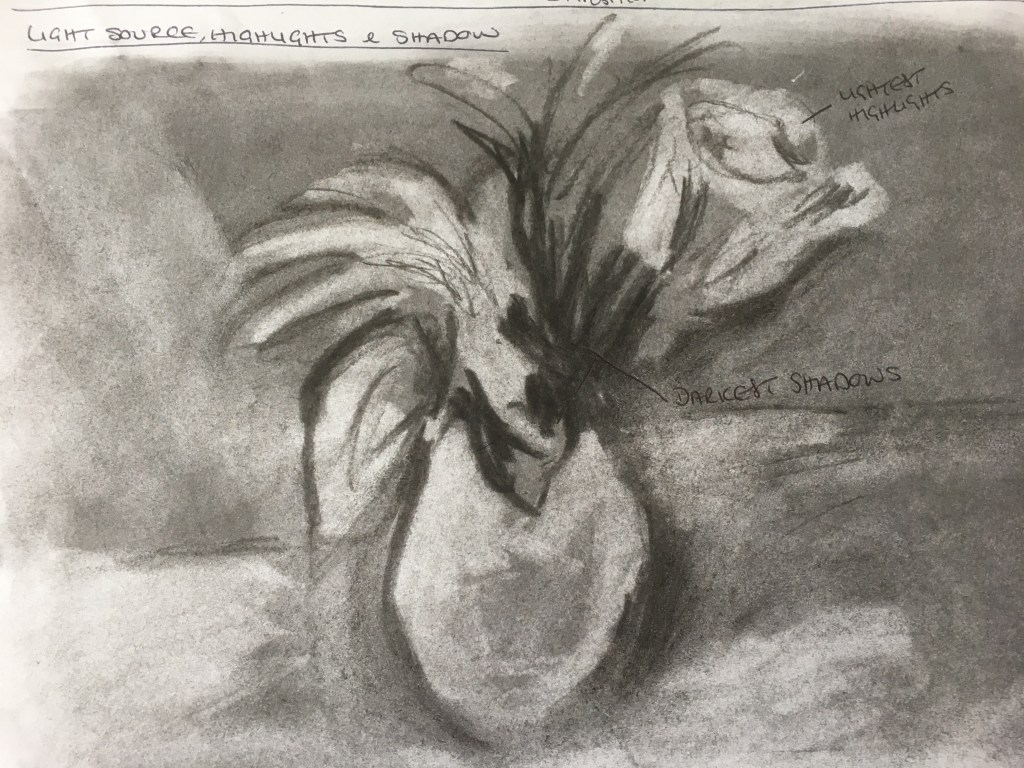
Light Source, Highlights and Shadow 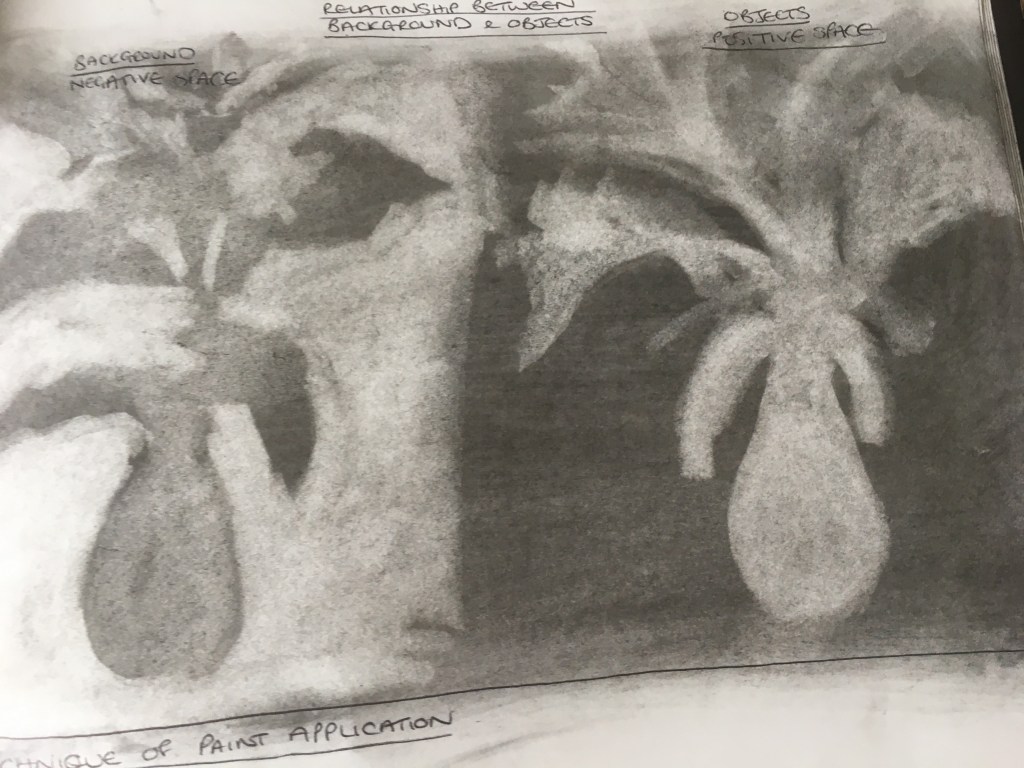
Relationship between Objects and Background 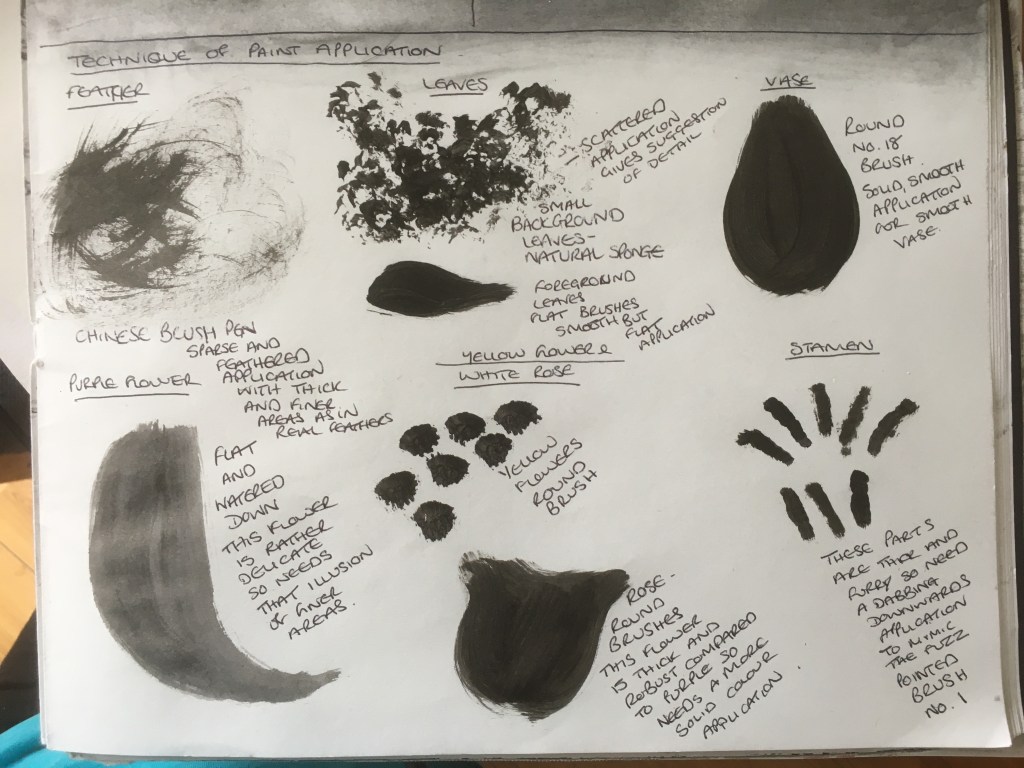
Application Techniques 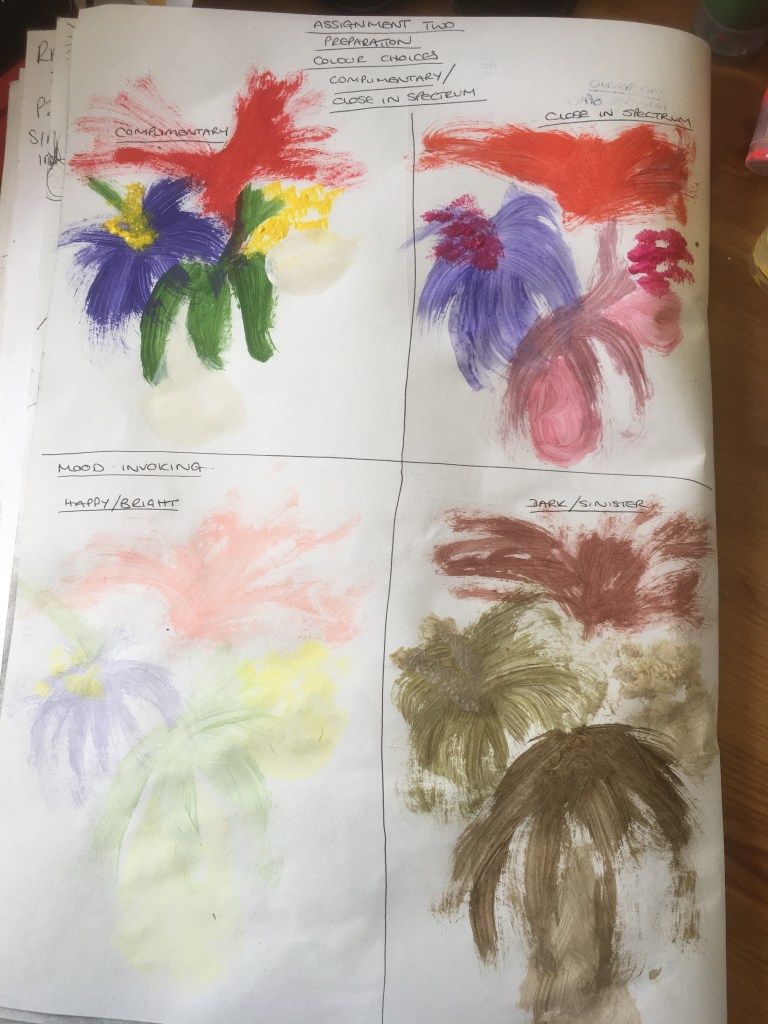
Colour Choices
Looking at the four different colour choices and considering my tutor’s comments regarding attempting to work in earthy tones, I decided that I would work with the colours within the bottom right experiment. The colours in this experiment were created by mixing the complimentary colours closest to the original colours in my set-up to achieve their earthy colours to create a muted version. Depending on the original colour, I mixed the two complimentaries in different ways. If, for example, the flower was purple, I allowed for more purple and less yellow in the mixture to keep it as close as possible, but to bring in that duller, muddier tone.
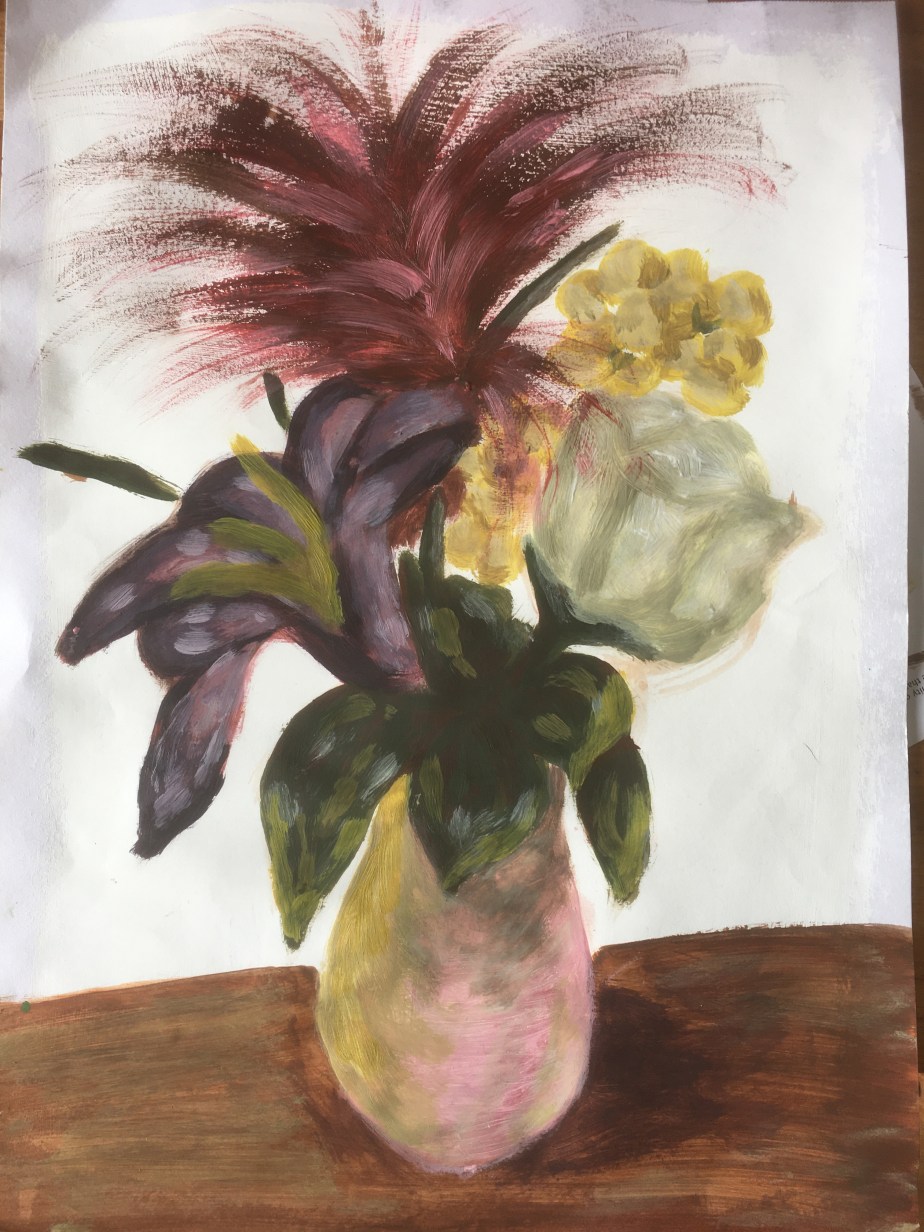
Final Piece
Stage 1 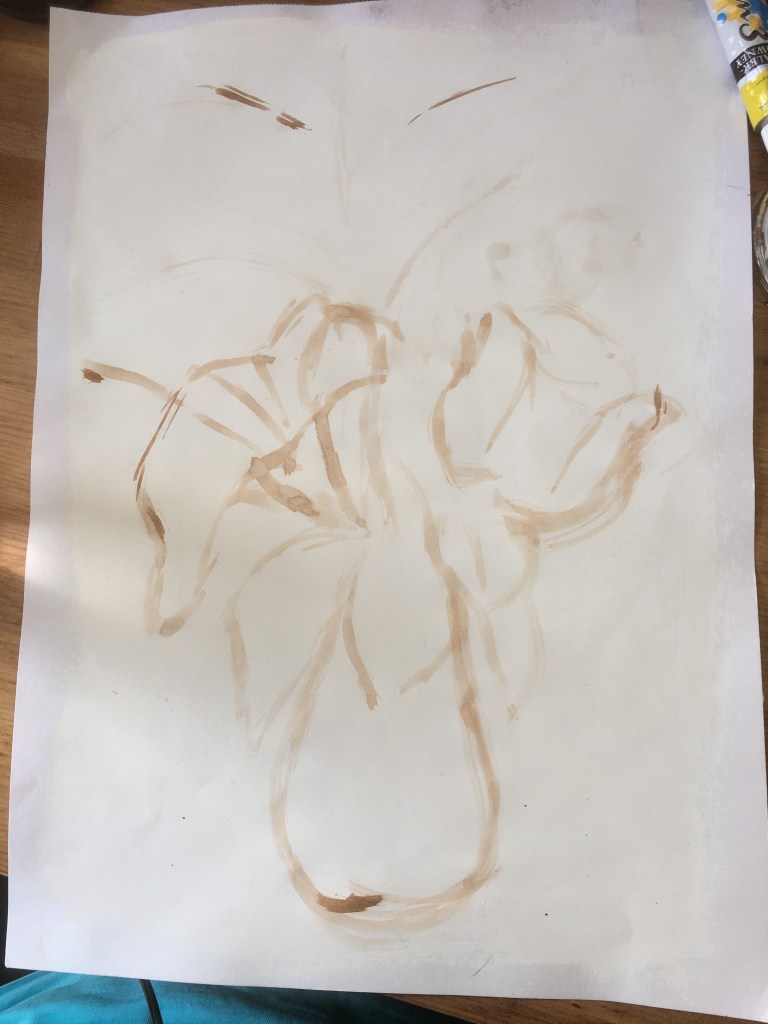
Stage 2
I created my final piece by building it up in several stages, as follows:
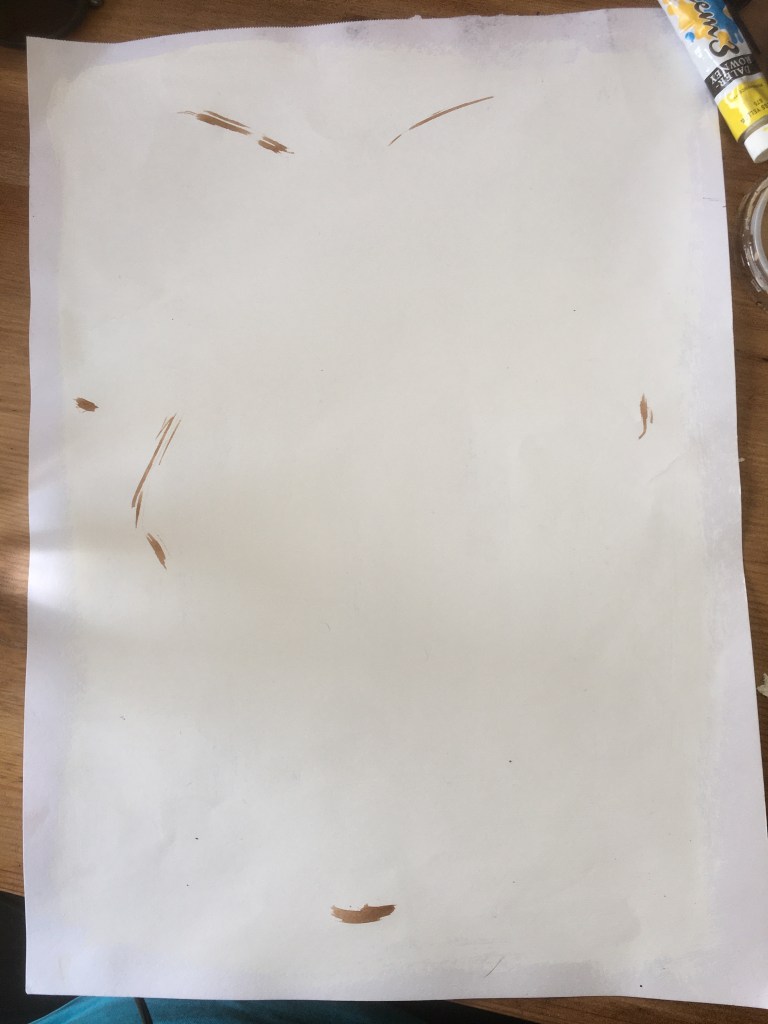
- Stage 1: I measured out the highest and widest parts of the composition on the page using a brown watered down . I decided to fill the page as much as possible with the composition so as not to have much excess space in the background.
- Stage 2: Next, I used the same wash to draw in the shapes of the objects in the composition, trying to keep them within the outlines I had placed initially. Looking at it now, I think I applied these initial lines too darkly and should have done them much lighter so as not to taint the final image if rather light in hue in that area.
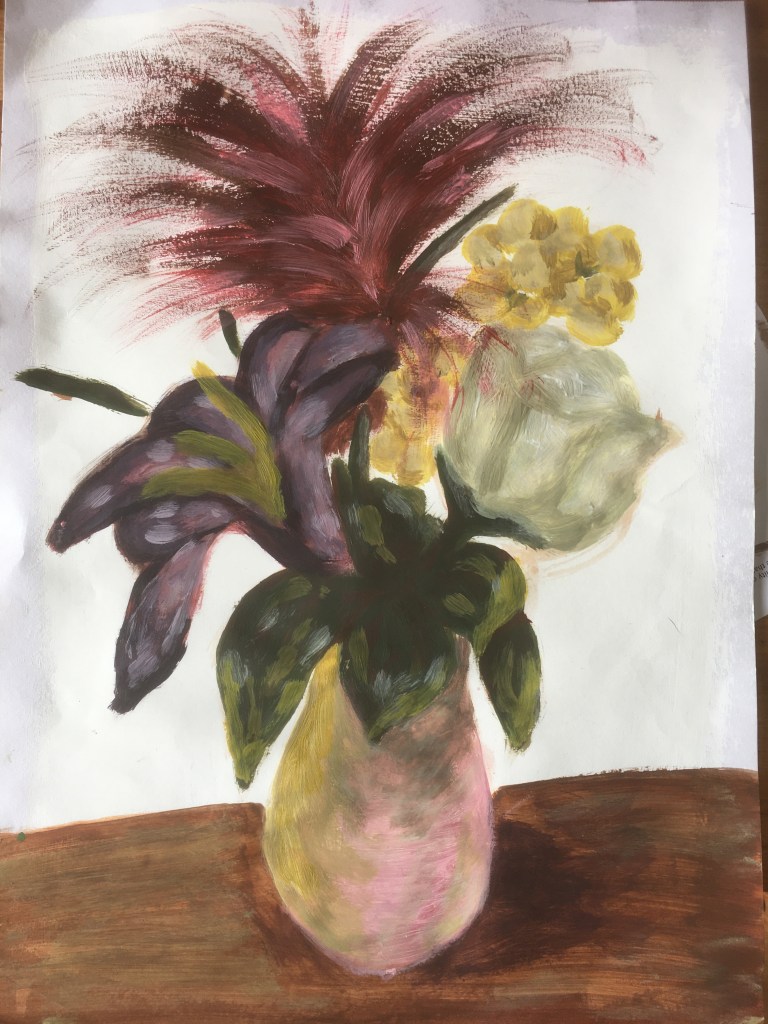
- Stage 3: I then began to apply the paint, starting with a medium hue of my chosen colours. As stated above, I chose to take the base colours and mix them with their complimentary colour to create a duller hue and thus a moodier atmosphere within the piece with earthier colours.
Reflection
Looking at my finished piece and comparing it with that of Part 1’s assignment piece, I feel I have loosened up quite a fair bit with my techniques and have developed quite the appreciation for the Impressionistic style as I really enjoy short dabs of paint in quick succession. I think I have managed to create some interesting colours within the vase, however, some of the techniques I tried to consider for each object did not work out. Again, I tried to let the piece develop naturally without too much in the way of manipulation to create a perfect piece. Looking back, I am slightly disappointed that I did not feel comfortable enough to be completely loose within the piece as I cannot get the quick study I did of the snail’s shell which was completely free and expressive. I will have to try and consider this more in the next part.
Overall, I am happy with my achievements in this assignment and think I have applied quite a lot of the things studied within this part without trying to cram in too much.
 Rachael's OCA Blog: Painting One: The Practice of Painting